

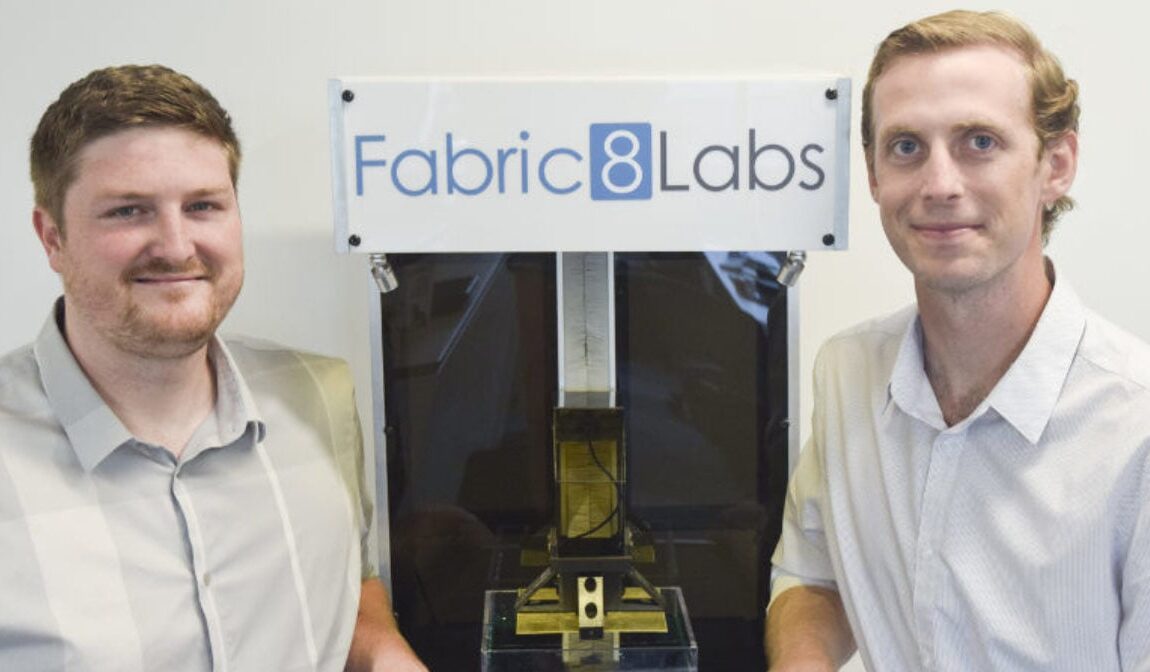
Fabric8Labs, the San Diego-based metal additive manufacturing company founded by Jeff Herman (Co-Founder & CEO), David Pain (Co-Founder & CTO) and his team, has taken a major leap forward with a fresh $50 million funding round. This investment marks a significant milestone in the company’s mission to reshape how high-performance metal components are designed and produced in the United States. With new capital flowing in, Fabric8Labs is preparing to expand its production capacity from 5 million to an impressive 22 million components annually, positioning itself as a key player in fast-growing technology markets.
ECAM Technology: Precision Built Atom by Atom
The backbone of Fabric8Labs’ rapidly rising demand is its proprietary Electrochemical Additive Manufacturing (ECAM) platform. This technology stands out from traditional metal 3D printing because it operates at room temperature, using an electrochemical process that builds metal parts atom by atom.
Without relying on heat or complex post-processing steps, ECAM creates components with exceptionally fine resolution and impressive surface quality. This level of precision makes the platform ideal for industries that depend on miniaturized metal components that must perform under intense conditions, including AI infrastructure, high-power computing systems, wireless communications, advanced electronics, and more.
As hardware continues to shrink while power increases, this type of scalable, high-precision manufacturing becomes not just beneficial, but essential.
A Funding Round Backed by Deep-Tech Leaders
The $50 million round was led by NEA and Intel Capital, two influential names in deep-tech investment. Existing investors Lam Capital, TDK Ventures, and SE Ventures reaffirmed their support, while new strategic investors including Marunouchi Innovation Partners, SK hynix, Ericsson Ventures, Masco Ventures, and Toppan Global Venture Partners joined the mission.
This strong investor participation highlights the growing confidence in Fabric8Labs’ potential to scale ECAM into a mainstream manufacturing solution. The new funding will help strengthen U.S. operations, expand engineering teams, support customer programs, and accelerate the company’s move into large-scale production for high-performance industries.
Also Read: Endolith Bags $13.5M to Push Microbial Chemistry Into the Mining Mainstream
Cooling the New Era of AI and High-Performance Computing
Thermal management is potentially one of the most impactful application areas for Fabric8Labs. The situation where effectively cooling advanced chips is becoming the main challenge as AI and high-performance computing systems are pushing power densities higher is clearly visible.
Fabric8Labs is employing ECAM to manufacture parts that kinetically interfaces with the chip and can be used in direct-to-chip or direct-to-silicon cooling, as well as immersion cooling, for system designs. These parts enable a stable operation condition in scenarios of a quick temperature rise, and where the utmost reliability is required. As AI is developing at an unprecedented speed, thermal management solutions of this kind are becoming the industry’s baseline.
Transforming Wireless Connectivity and RF Hardware
Fabric8Labs is also expanding its footprint in wireless and RF applications. Through its room-temperature ECAM process, the company can fabricate three-dimensional metal antennas directly onto printed circuit boards and high-performance substrates.
This approach supports applications where size, weight, and efficiency matter deeply, including low Earth orbit (LEO) satellites, wireless backhaul systems, and communication hardware in vehicles. Printing antennas directly onto substrates allows more compact designs, reduces assembly steps, and offers better integration compared to traditionally manufactured RF components.
Advancing Power Electronics for Electric Vehicles
Another area where ECAM is proving valuable is power electronics, especially for electric vehicles and dense energy systems. Fabric8Labs uses its technique to produce high-current interconnects and passive components directly on ceramic substrates.
By reducing material interfaces and minimizing assembly stages, the resulting systems are more compact, more efficient, and more reliable. For EVs and other high-power systems, these performance improvements can translate into better energy use and longer-lasting components.
Building a Stronger U.S. Manufacturing Backbone
A significant part of Fabric8Labs’ expansion plan centers on domestic production. The company’s facility is ISO 9001 certified and ITAR registered, reinforcing its commitment to quality, safety, and secure manufacturing practices.
As global supply chains face ongoing uncertainty, the ability to offer U.S.-based prototyping and volume production gives Fabric8Labs an edge, especially for customers building mission-critical technologies. The company also plans to open its expanding production site to industry partners, giving them insight into how ECAM operates at scale.
Also Read: OneLogica: A Cloud-Native Journey Toward Intelligent Transformation
















