

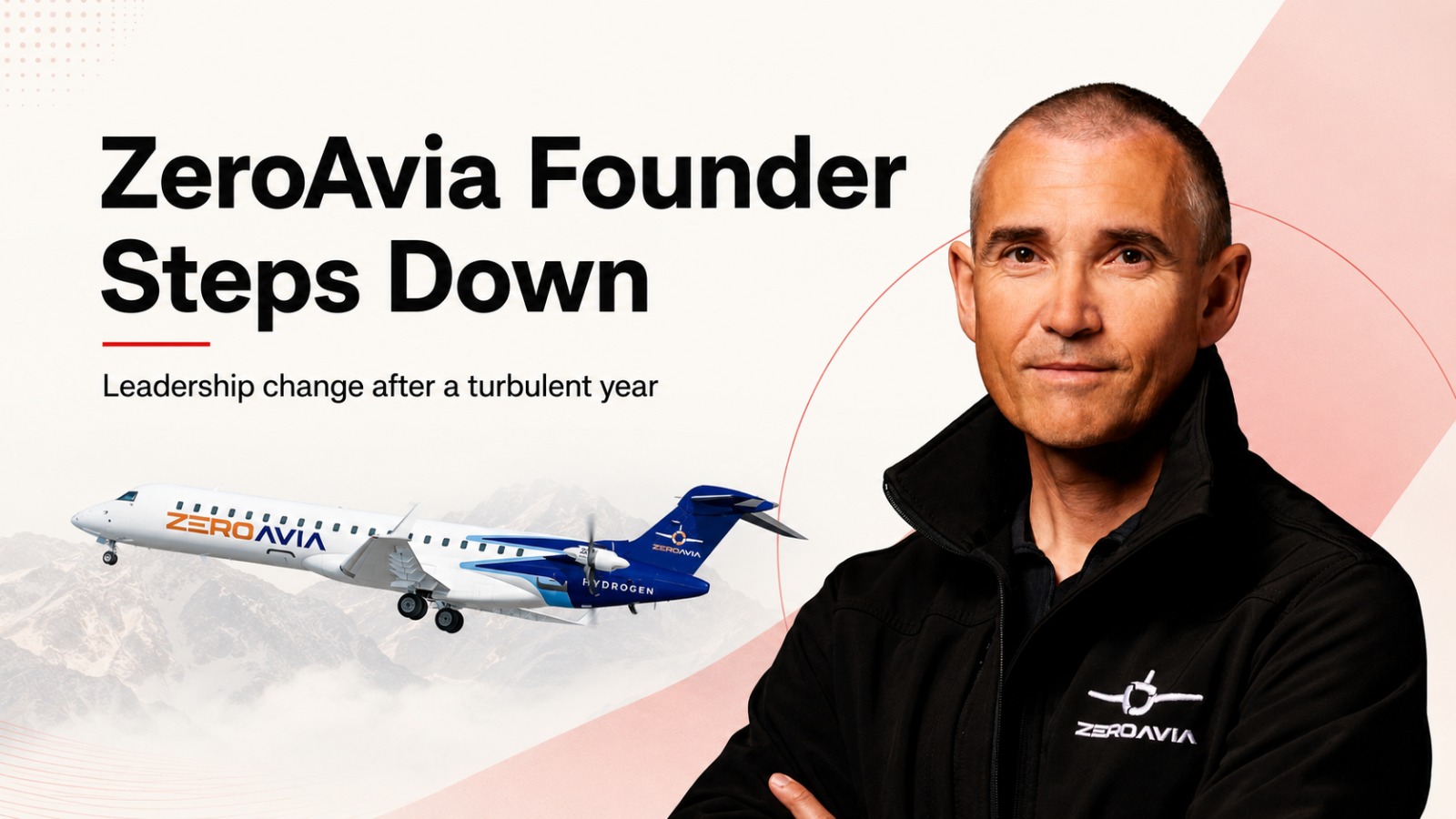
Val Miftakhov, the founder and chief executive of ZeroAvia, has stepped down from the top role at the hydrogen propulsion startup, marking a major leadership shift at one of the most closely watched names in clean aviation.
ZeroAvia announced on May 29 that Miftakhov had left the CEO position three days earlier to pursue new opportunities. He will continue to serve on the company’s board and support its long-term strategy.
For now, executive chair Christine Ourmieres-Widener has taken charge of day-to-day operations while the board looks for a permanent successor.
The change comes at a sensitive moment for ZeroAvia. The company has spent years trying to prove that hydrogen-electric propulsion can move from test flights and engineering milestones into certified aircraft systems. That promise has attracted attention across aviation, but the past year has also exposed the pressure facing companies trying to commercialise new aircraft technologies.
From Founder-Led Vision to Execution Pressure
Miftakhov founded ZeroAvia in 2017 with the aim of bringing hydrogen-electric propulsion into commercial aviation. Under his leadership, the company became one of the most visible players in the sector, drawing support from airlines, aircraft manufacturers and government agencies looking for lower-emission alternatives to conventional propulsion.
The company’s work has centred on hydrogen-electric systems for regional aircraft. ZeroAvia has also flight-tested its ZA600 powertrain, a key technical step in its development journey.
But turning technical progress into certified aviation hardware is a far harder test. ZeroAvia is now targeting certification of its ZA600 fuel-cell system in 2027. Approval for the complete propulsion system is expected later and will depend partly on the availability of funding.
The company is also developing the larger ZA2000 powertrain for higher-capacity aircraft.
A Year of Cuts and Reset
The leadership change follows a period of restructuring at ZeroAvia. The startup carried out workforce reductions across its operations in the United States and the United Kingdom as it tried to conserve cash and align spending with its development priorities.
Those cuts ultimately removed roughly half of the company’s employees.
Even after the restructuring, ZeroAvia secured fresh investment in late 2025 from existing and new investors. The funding gave the company additional resources to continue work on its hydrogen-powered technology, but the central challenge remains unchanged: moving from promising demonstrations to certified products that can be used commercially.
Miftakhov’s exit does not end ZeroAvia’s story. In some ways, it marks the beginning of a more difficult chapter.
Founder-led startups often thrive on ambition, speed and belief. Aviation certification works differently. It demands patience, documentation, capital discipline and regulatory confidence. For ZeroAvia, the next phase will be less about proving that hydrogen-electric flight can work in principle and more about proving that it can meet the standards required for commercial use.
The company’s path also reflects wider questions facing hydrogen aviation: airport infrastructure, certification requirements and the pace at which airlines can realistically adopt new propulsion systems.
ZeroAvia has already shown technical progress. Its next task is to convert that progress into a certified, fundable and commercially relevant product. That challenge now falls to a company entering a new leadership phase, with its founder still present on the board but no longer running the business day to day.
Also Read: Who Owns Your Team Now? IPL’s Latest Ownership Breakdown
















