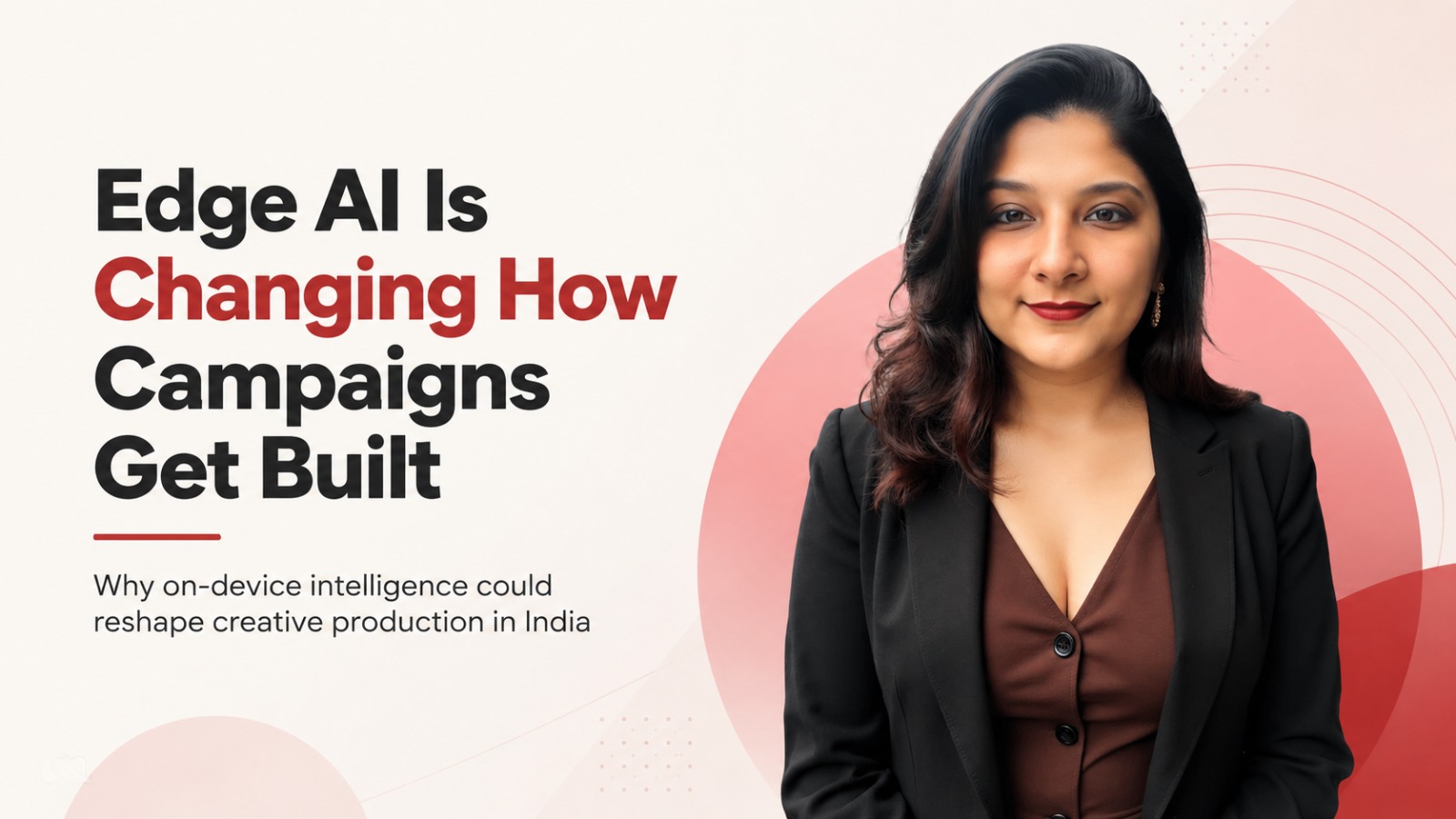
By Khushboo Mulani, Founder & ShEO, Slay Media
Edge AI is coming for creative production, and it will change everything about how campaigns get built in the future.
There is a moment on every production shoot that anyone who has run a creative agency will recognise. The client is on location. The shot is done, more or less. The team is exhausted, and then someone asks that question that used to have only one honest answer: “Can we see what this will look like finished?”
The honest answer, for most of production history, was not until post. Not until the footage goes back to the edit suite, through colour grading, through the VFX pipeline, through review rounds that take days, or weeks. The gap between capture and output was structural, baked into the hardware limitations of on-set devices and the processing power needed to do anything meaningful with raw footage in real time.
But that gap is closing. And the tech that is closing it isn’t really a faster internet connection or a shiny new cloud platform. It’s Edge AI, where artificial intelligence processing moves from remote servers to the devices themselves. Phones. Cameras. Laptops. On-device chips are doing sophisticated AI inference locally, without sending data to a cloud and waiting for a response.
For India’s creative and production industry, this isn’t a small upgrade. It’s a structural shift in how campaigns get built.
What Edge AI Actually means on set
Cloud AI vs. Edge AI is basically where the computation happens. Cloud AI sends data to a remote server, processes it, and then returns the result. For many applications, that approach works. Creative production is different because most output has to be time-compressed, where decisions in the moment determine what exists to work with later.
So the ability to process and iterate on creative output in real time, right on the device in the director’s hand, or on the laptop sitting on the production table is game changing.
Apple’s Neural Engine, Qualcomm’s Snapdragon AI processors, and AI-optimised chips in professional cameras and laptops are already making on-device inference fast enough to run generative and analytical AI tasks locally. The iPhone does real-time computational photography using on-device AI. Professional camera systems are starting to integrate AI-powered scene analysis at the point of capture. Laptops with dedicated AI processing units can run local models without any cloud dependency.
The trajectory is clear: within two to three years, the AI processing power available on a professional production device will be enough to fundamentally change what’s possible on set, on location, and in the studio.
What this mean specifically for Indian production
India’s content production ecosystem has traits that make the edge AI shift feel extra important here.
First, the geography of production is vast and uneven. Campaigns are shot in places where connectivity is unreliable, or just absent. Cloud-dependent AI tools that run smoothly in a Mumbai studio become kind of dead on a hillside in Himachal Pradesh, or on a beachfront in Kerala. Edge AI removes that dependency completely. Advanced creative tooling becomes available wherever the shoot can go, not only where the internet cooperates.
Second, the pace of Indian advertising production is relentless. Timelines are compressed. Client review cycles get baked into shoots. Showing a finished-looking frame, or a colour-graded sequence while still on location, instead of days later in post, compresses the production cycle in a way that has direct economic weight. Fewer revision rounds. Faster approvals. Less post-production spend on directions that could’ve been spotted earlier.
And for D2C and performance-focused brands, the implications go even further. Real-time creative variation, generating multiple versions of a visual asset on set, rather than waiting for a post-production pipeline, means performance testing that usually happens after launch could start during production itself.
Shoot ten variations of a product frame, run preliminary AI analysis on which compositions might perform better, and then prioritise the post-production pipeline accordingly. The feedback loop between creative production and performance data tightens dramatically.
The skills the industry hasn’t really confronted
Edge AI’s arrival forces a capability question that creative production hasn’t fully handled yet. The professionals who extract the most value from on-device AI aren’t necessarily the most technically sophisticated people. Often, they’re the ones who understand both the creative brief and the AI tooling well enough to use that real-time capability on purpose, and not randomly.
A cinematographer who knows how on-device AI helps with composition, or a creative director who can evaluate AI-generated variations against a brand brief in real time, is a more valuable asset than the same professional without that fluency. Agencies and production houses that build this capability inside their teams, instead of treating AI as some post-production specialist thing, will gain a structural efficiency advantage in the next phase of the industry.
The hardware investment question is also very real. AI-enabled cameras, Apple Silicon laptops, next-generation smartphones with dedicated neural processing units all demand capital allocation. Smaller production operations may find it tough. Like most tech transitions, early advantage tends to go to the teams that invest ahead of mainstream adoption.
The Shift That’s Already Happening
Edge AI doesn’t just change the tools that are available in production. It also changes what a production fundamentally is, shifting it away from capture, then creation and into capture plus creation happening at the same time.
That move has real implications for how campaigns are briefed, how production is budgeted and even how fast a brand can go from a concept to a live asset. The agencies and brand teams that are building workflows and skills for an edge AI environment now will probably see the transition as an advantage. Not a disruption.
Basically the distance between capture and creative output is getting smaller. For brands and agencies ready to meet it, what’s on the other side is worth watching right now.
Also Read: Vaibhav Suryavanshi’s Rise Is Bigger Than a Net-Worth Number