

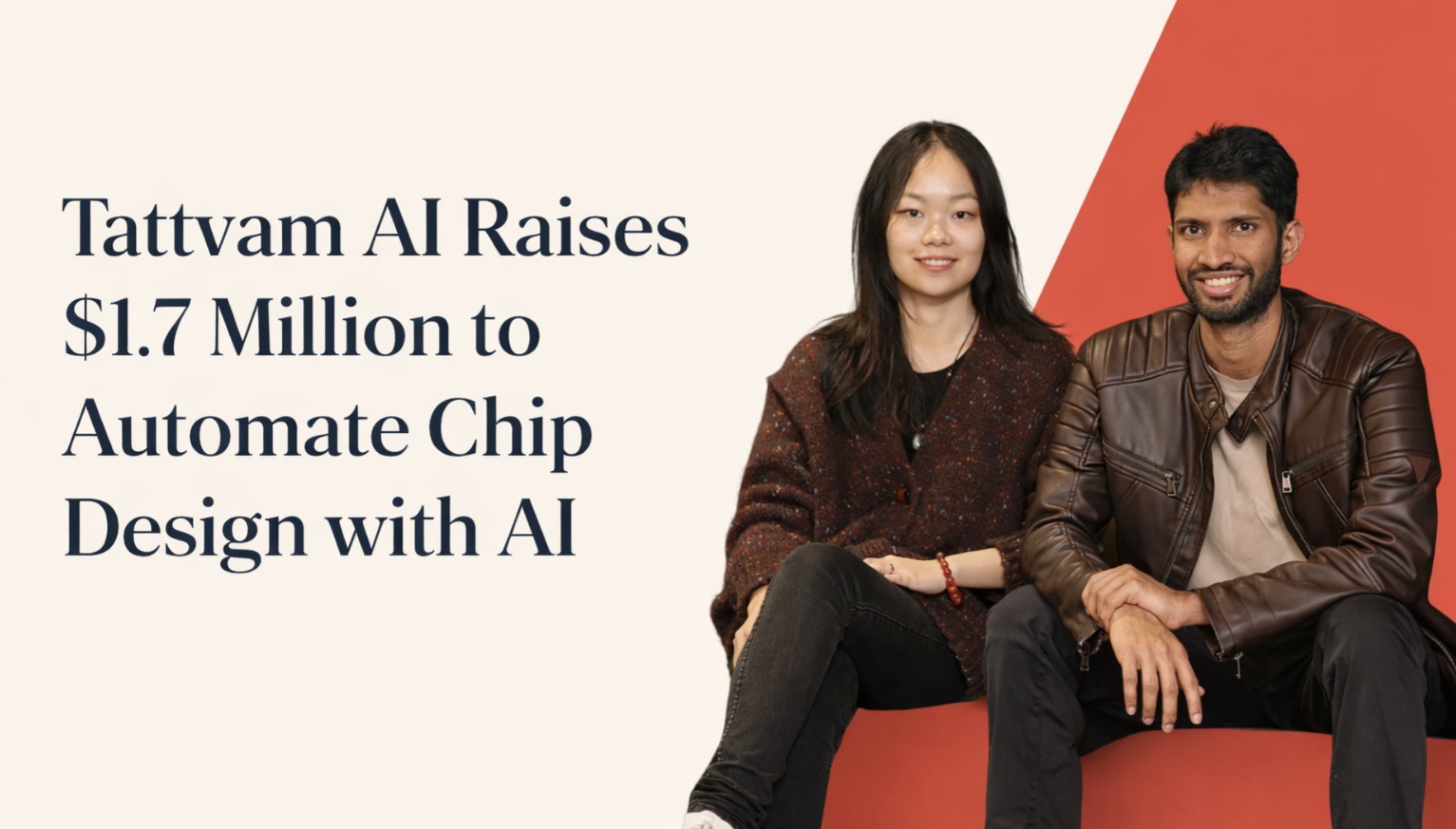
Tattvam AI, a London-based deeptech startup working on AI systems to automate semiconductor chip design, has raised $1.7 million in pre-seed funding as it comes out of stealth. The round was led by Seedcamp, with participation from EWOR, Entropy Industrial Ventures, Concept Ventures, and semiconductor angel Stan Boland, the company said.
The announcement lands at a moment when the global race for custom silicon is accelerating. Unlike general-purpose chips meant to handle a wide range of tasks, custom silicon is built for specific workloads, such as AI training or AI inference, where tighter optimisation can improve performance and power efficiency for a targeted use case. As AI models scale and compute-heavy applications expand, more companies are exploring specialised chips as a competitive edge.
But the biggest bottleneck remains the same: designing chips is slow, complex, and heavily manual. The development cycle can stretch for years, and the pool of engineers capable of handling advanced design workflows is limited. Tattvam AI’s pitch is straightforward, bring the speed and leverage of modern AI into the engineering heart of semiconductor development.
What Tattvam AI is building?
Tattvam AI says it is developing an AI layer for chip design, an AI system that can understand circuit structure and autonomously solve complex design tasks. The company describes chip design as a reasoning-heavy problem across a vast search space, where deep structural understanding matters more than surface-level pattern matching.
CEO and co-founder Bragadeesh Suresh Babu said the company is building a “reasoning model” that understands circuits from first principles, constraints, trade-offs, and interdependencies, with the goal of operating like a top-tier engineer, but faster.
The company’s stated ambition is to reduce what typically takes 2–3 years to weeks, by automating key parts of the design process, reducing costs, and enabling faster iteration on chip designs.
Why the timing matters?
Chip design has long been dominated by specialised tools and highly trained teams. Even as software development has seen major productivity gains from AI-assisted coding, hardware design has lagged because circuits demand rigid constraint satisfaction, careful verification, and nuanced engineering judgement.
At the same time, demand for specialised compute keeps rising. As more applications, from autonomous systems to scientific research, push the limits of performance and energy efficiency, the appeal of purpose-built silicon has grown.
That creates a widening gap between what the market wants (more chips, tailored faster) and what current workflows can reliably produce (slow, expensive, capacity-constrained development).
Tattvam AI is positioning itself as a bridge across that gap, using AI to reduce the manual burden and compress timelines.
Founder background and team
Tattvam AI was founded by Bragadeesh Suresh Babu, an IIT Madras alumnus, along with Lannan Jiang, who has been developing chips at a research lab at ETH Zurich.
Bragadeesh’s early interests, the company said, were shaped by mathematics and competitive Olympiads before he moved into AI and hardware. His prior experience includes work as an early engineer at UK-based brain-monitoring startup CoMind, and later as one of the earliest engineers at UK-based chip startup Fractile.
The company also said Bragadeesh turned down an offer to join Google’s TPU team to build Tattvam AI.
What investors are backing
Semiconductor veteran Stan Boland described Bragadeesh as a compelling founder and said the company’s focus on speeding up the iterative process of using EDA tools and models to design chips could resonate with top engineering teams.
Boland is cited as a former founder/CEO at Icera (acquired by NVIDIA) and Element 14 (acquired by Broadcom), according to the company.
Tattvam AI said it plans to launch its first product in the coming months and is working with partners as it moves toward accelerating the development of next-generation chips.
Also Read: How Mokobara Is Redefining Travel for Modern India
















