

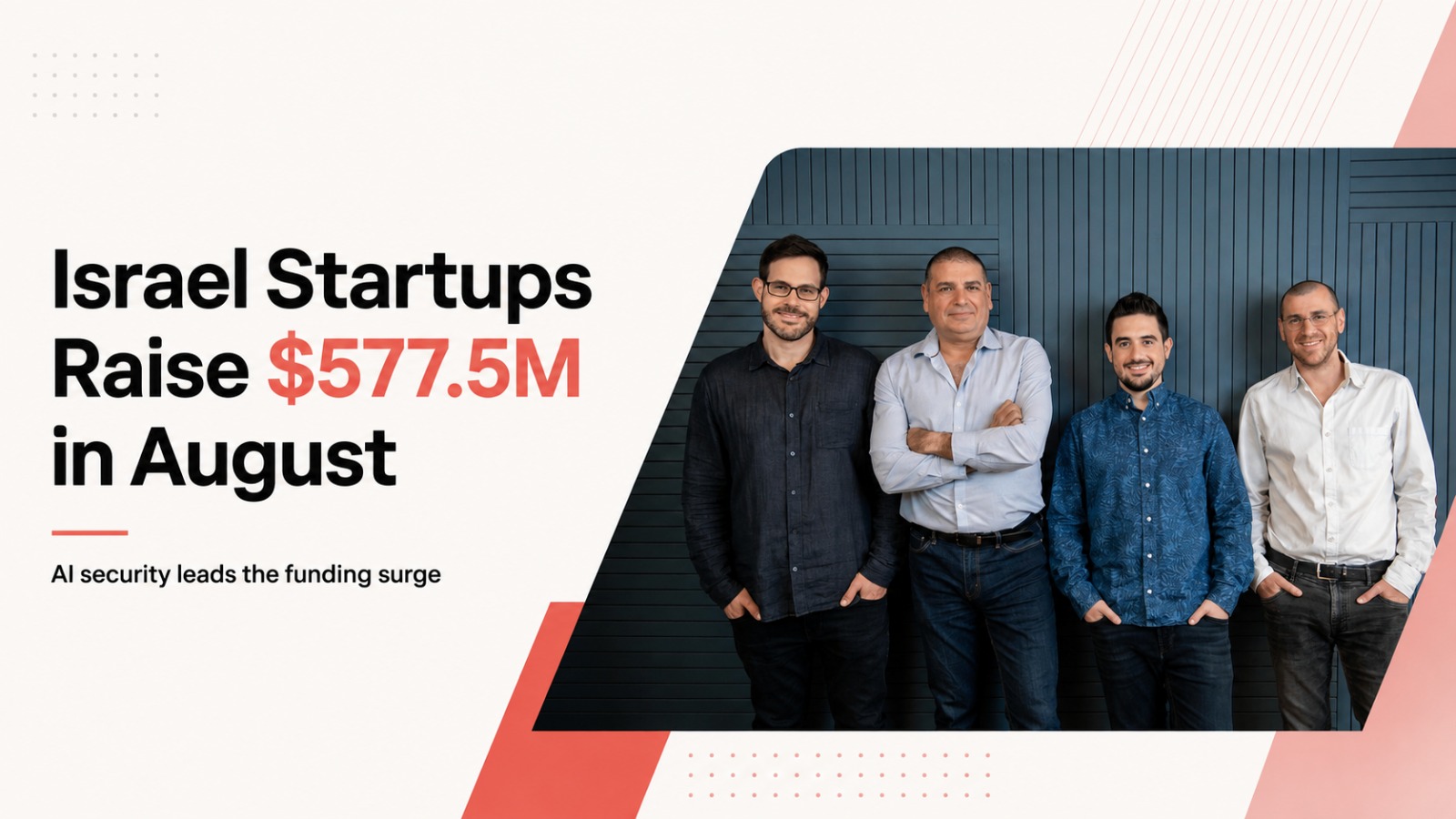
Israeli startups announced at least $577.5 million across 12 disclosed funding rounds in August 2026, while a separate investment in cybersecurity company Above was announced without a disclosed amount. The month stood out not only for the size of the funding, but for where investors were placing their bets: securing AI systems, autonomous agents and enterprise deployments.
Israel’s startup funding market had an unusually active August, with companies announcing at least $577.5 million in capital across a dozen disclosed rounds.
A 13th investment, involving cybersecurity startup Above, was also announced during the month, although the size of that deal was not made public. The total made August 2026 the strongest August for Israeli startup fundraising since 2022, despite the month traditionally being quieter because of summer holidays.
What made the month particularly notable was the concentration of capital around a problem that is becoming harder for enterprises to ignore: artificial intelligence is creating a new security surface of its own.
Several of the companies that raised money in August are working on protecting AI models, monitoring autonomous agents, defending businesses from AI-assisted cyberattacks or helping enterprises move AI projects beyond pilots and into production.
Alice and Zenity lead the month
Alice recorded August’s largest disclosed round, raising $140 million at a valuation of between $700 million and $800 million.
The company is taking its experience in identifying malicious online behaviour into the emerging market for securing AI models and agents.
Close behind was Zenity, which raised $125 million in a Series C round. The financing brought the cybersecurity company’s total funding to $185 million and is intended to support its global expansion.
Zenity is focused on autonomous AI agents, a growing category of software capable of carrying out tasks with less direct human involvement. As companies deploy more of these systems, security is increasingly shifting from simply controlling who can access corporate applications to understanding what AI agents can actually do after they are given access.
Together, Alice and Zenity raised $265 million during the month, making the emerging security layer around AI agents one of the clearest themes in August’s funding activity.
Cybersecurity money moves closer to live AI systems
Oligo Security and Corma each announced $60 million rounds, although they are approaching the changing threat landscape from different directions.
Oligo is focused on runtime security. Its premise is that AI-enabled attackers can identify vulnerabilities faster than businesses are able to patch them, creating a need to protect applications while they are actually running rather than relying only on fixes made before deployment.
Corma raised a $60 million Seed round to develop a foundation model designed specifically for defensive cybersecurity. The company is working from the view that increasingly capable general-purpose AI systems can strengthen offensive cyber capabilities, while specialised defensive models will be needed on the other side.
Smaller rounds reinforced the same pattern.
Attestable raised $20 million to explore the use of zero-knowledge cryptography for verifying activity inside powerful AI systems. Its backers include alumni of RAND, Unit 8200, StarkWare and Safe Superintelligence.
Arrakis Security secured $8 million in Seed funding. Founded by former Palantir and Torq employees, the startup is developing security systems aimed at tracking what autonomous agents do after gaining access to enterprise environments.
Above also received a strategic investment from CrowdStrike, although the amount was not disclosed. The investment strengthens the startup’s integration with CrowdStrike’s Falcon platform and centres on AI-native security technology designed to monitor risks involving trusted users as well as external attackers.
AI funding stretches beyond cybersecurity
Not every major August deal was a cybersecurity round.
Travel fintech Faye raised $50 million in a Series C at an estimated valuation of $500 million. The company plans to use AI to automate parts of the insurance claims process while expanding internationally.
QuantHealth raised $45 million in Series B funding for its AI simulation technology used in clinical trials. The company says its platform has simulated more than 600 trials and is designed to help drugmakers evaluate decisions before enrolling patients or making large development commitments.
Remepy secured $36 million in a Series A as it prepares its AI-driven Hybridopa treatment for Parkinson’s disease for Phase III. The company has also expanded its work into rare tumours through a partnership with Merck.
Enterprise AI adoption produced another pocket of activity. June AI raised $20 million in a pre-Seed round from Marc Benioff and Michael Dell. Founded by the team behind Bonobo AI after five years at Salesforce, the company is developing AI agents aimed at automating software implementation work.
Xpander, founded by former AWS engineers, raised $7.5 million in Seed funding to build infrastructure that allows businesses to deploy AI agents across different models, cloud environments and workflows.
Another $6 million went to IAIG, founded by former Simplex founders, which plans to build multiple AI-native software companies around the changing economics of software development.
August’s funding tells a broader AI story
The August numbers show that investor interest is no longer concentrated simply on companies building new AI models or adding generative AI features.
A meaningful share of the month’s activity instead went to companies dealing with what happens after AI reaches real businesses: how autonomous agents are controlled, how applications are protected while running, how AI-led attacks are countered and how large organisations move AI systems into everyday operations.
That distinction helps explain why cybersecurity featured so prominently in one of Israel’s strongest August funding performances in recent years. The next phase of enterprise AI appears to be creating demand not only for smarter software, but also for an entirely new layer of infrastructure around how that software behaves.
Also Read: Jim Curtis Finally Opens Up About Jennifer Aniston















