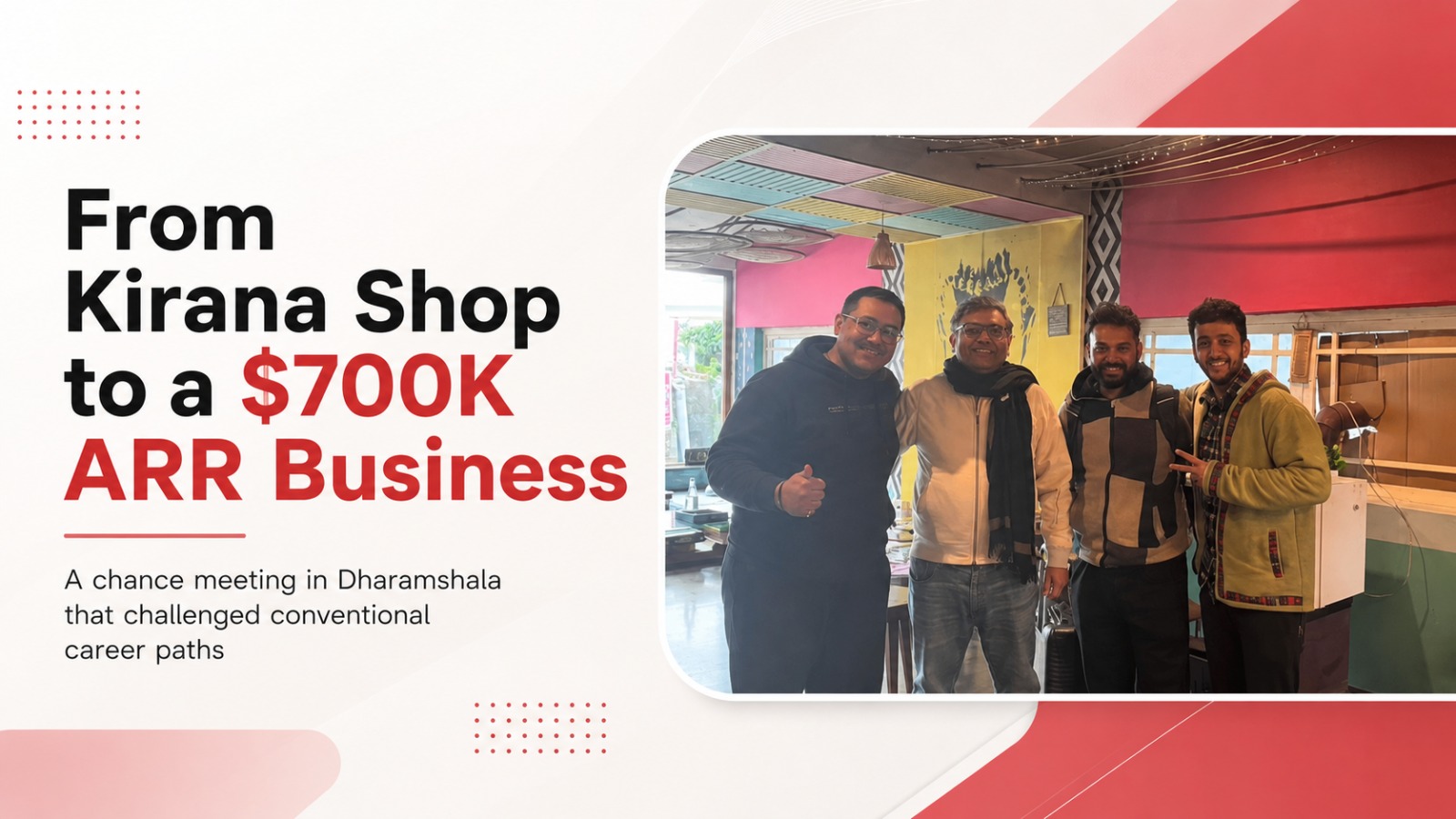
A conversation around a Kirana Shop in Dharamshala has changed the way startup founder Harshil Tomar looks at careers, entrepreneurship and the possibilities that exist outside familiar corporate circles.
In a post shared on X, Tomar said he met a man who had moved from running a neighbourhood kirana shop to operating a business with annual recurring revenue of about $700,000. The business, he added, was being managed by a team of only two people.
At current approximations cited in reports about the post, that annual revenue works out to roughly Rs 6 crore.
Tomar did not reveal the name of the entrepreneur, the company or the sector in which the business operates. The revenue figure, therefore, remains a claim made in his account of the meeting. What stayed with him, however, was not simply the size of the business. It was the distance the entrepreneur had travelled from a conventional retail shop to a compact, high-revenue operation.
A business world rarely seen from corporate offices
Tomar, who has been identified as the founder of Dream Launch Studios, used the encounter to reflect on how urban upbringing can shape a person’s understanding of work.
“Growing up in a city teaches you a narrow menu of careers,” he wrote, listing familiar functions such as technology, marketing, sales and human resources.
People often choose one of these recognised paths and spend years progressing within its accepted boundaries. Tomar’s experience in Dharamshala showed him a different working world, one filled with highly specialised businesses that may remain almost invisible to those inside traditional companies and startup networks.
The former kirana shop owner was not the only person who caught his attention.
Tomar also described meeting someone whose work involves helping people navigate international visa processes. He admitted that he had previously known little about the everyday operations of such a business.
The encounter appears to have made him realise that entire industries can exist outside a person’s immediate professional awareness, even when those industries solve problems faced by thousands of people.
An MNC professional who built a trading engine for himself
Another person Tomar met had left a major multinational company and developed a deep interest in quantitative trading.
According to the post, the former corporate employee used Claude to build his own trading simulation engine. The system was not created as a commercial product or a startup idea. It was built solely to support his personal trading activity.
That distinction appears to have impressed Tomar.
In the startup world, technology is often discussed in terms of customers, fundraising, market size and scale. Here, he had encountered someone using advanced tools for a narrowly defined personal objective, without trying to convert the project into a company.
Tomar said the trader possessed greater clarity about that single area of work than many founders display while explaining their entire businesses.
The observation shifts attention away from company size and job titles. It suggests that depth of knowledge, independence and a clearly understood problem can sometimes matter more than operating within a recognised industry.
Reading about niche businesses is not the same as meeting their builders
Small, specialised and highly profitable businesses are frequently discussed online. They are often presented as case studies, revenue screenshots or examples of unconventional entrepreneurship.
For Tomar, meeting the people behind such work made the idea more tangible.
He wrote that reading about niche businesses and sitting across a table from someone actually running one were “two completely different experiences”.
The encounters also challenged a common assumption that meaningful businesses require large teams, expensive offices or visible public profiles. In the example he shared, two people were reportedly responsible for an operation generating $700,000 in annual recurring revenue.
The post does not provide enough information to evaluate the company’s profitability, expenses, customers or business model. ARR represents recurring annual revenue and should not be confused with profit or personal income. Still, the scale claimed by Tomar stands out because of the unusually small team behind it.
A wider lesson about career boundaries
The strongest part of Tomar’s account is not the revenue figure. It is the idea that people often build their expectations around the careers they happen to see while growing up.
Someone surrounded by corporate professionals may believe the safest options are engineering, consulting, sales, marketing or management. Someone exposed to independent operators may see opportunities in specialised services, software tools, trading systems or small digital businesses.
The difference is not necessarily talent. It can simply be exposure.
Tomar’s Dharamshala meetings offered him direct evidence that people were building serious livelihoods in areas he had barely considered. Some had moved beyond the professions they started in. Others had developed expertise in narrow fields that rarely attract public attention.
His closing reflection captured the larger message of the post: people may not understand what is possible until they spend time with those who have already moved beyond the limits they once accepted.
The former kirana shop owner’s journey remains largely undisclosed. There is no company name, detailed financial record or explanation of how the business reached the claimed revenue level. Yet the story has value precisely because of the question it raises.
How many viable careers and businesses remain invisible simply because they fall outside the small circle of options most people are taught to recognise?
Also Read: Manogya Loiwal Elevated to Executive Editor at NDTV