

Deepinder Goyal is moving into a new phase of entrepreneurship after stepping down as chief executive of Eternal, the company formerly known as Zomato.
His next bets could hardly be more different. One is a premium wearable designed to track changes in the body’s metabolic state. The other is an aviation venture seeking to connect smaller Indian cities, towns and villages through short-haul aircraft and local airstrips.
Both projects reflect Goyal’s willingness to pursue ideas that carry significant technical, regulatory and commercial risk.
Temple wearable targets athletes, founders and executives
Goyal plans to introduce a bean-shaped wellness device called Temple, named after the part of the forehead where it is worn.
He has said the device is intended to measure the body’s metabolic state in real time. The launch could take place within six months, although the timeline may extend to a year.
Temple grew out of an internal experiment focused on understanding cerebral blood flow. During that work, Goyal’s team identified a metric he calls “entropy”, which he says is linked to metabolic rate and may help track changes associated with stress, meditation, recovery, sleep and exercise.
Those claims have not yet been independently validated by scientists. The product has also not received medical regulatory approval.
Goyal has said Temple will be introduced as a wellness product and supported by peer-reviewed studies. Until such research is published and independently examined, its performance claims remain unproven.
That distinction will matter in a wearable technology market already filled with watches, rings and fitness trackers measuring heart rate, sleep patterns, physical activity and recovery.
Goyal’s argument is that most existing products use heart rate as an indirect indicator of metabolic activity, while Temple is being developed to measure metabolic rate more directly.
A premium product, not a mass-market device
Temple is expected to cost about $1,000, placing it well above the price of most mainstream fitness trackers.
The intended audience is also deliberately narrow. Goyal has described the device as a product for high-performing users, including athletes, company founders and senior executives, rather than the wider consumer market.
That positioning suggests Temple will initially compete on specialised insights and exclusivity, not affordability or scale.
It will be the first commercial product from Goyal’s new venture following his departure from Eternal’s top executive role in February. Eternal’s businesses include food delivery, quick-commerce operations and event ticketing.
LAT Aerospace looks beyond India’s major airports
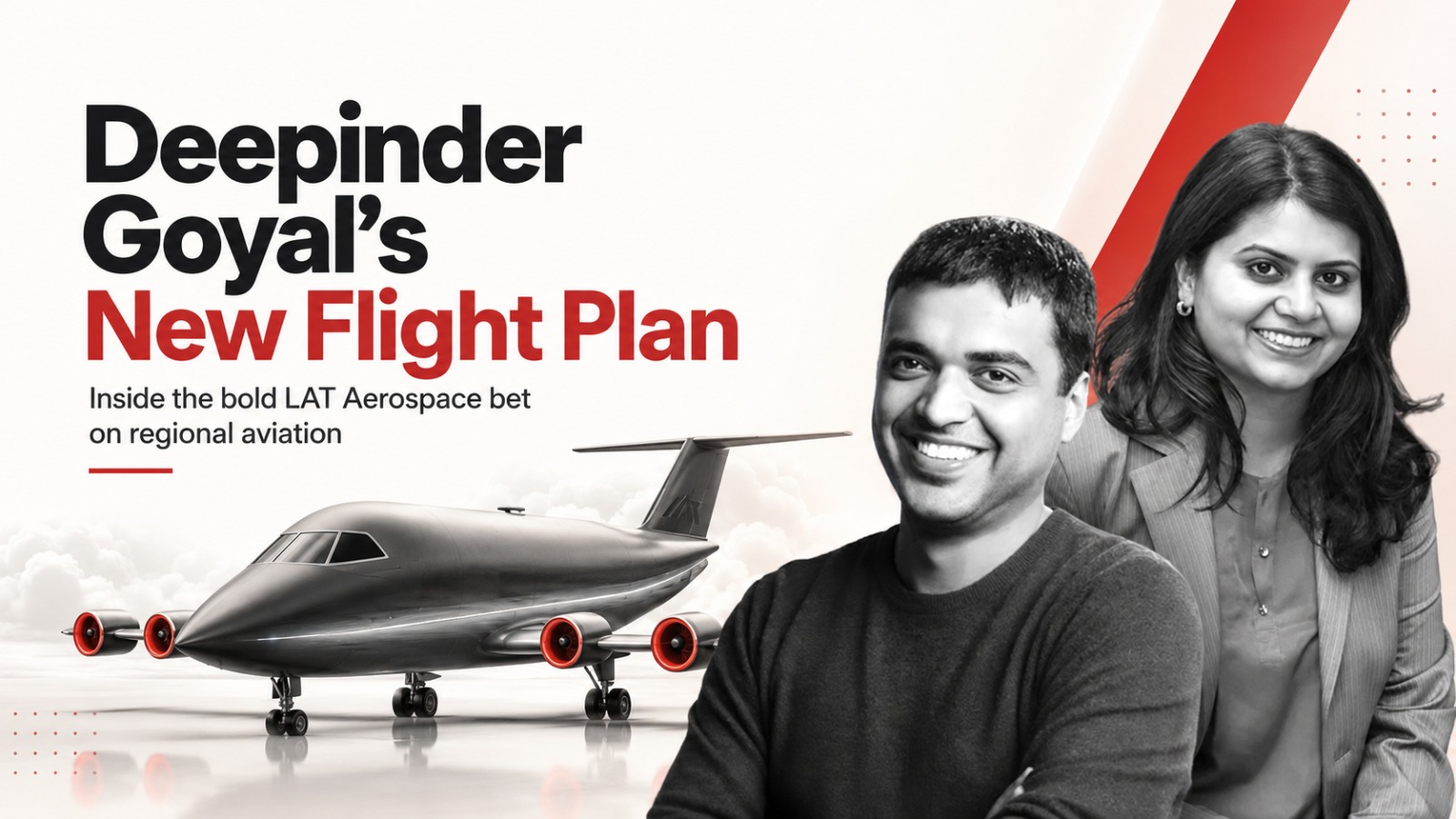
Goyal is also backing LAT Aerospace, an aviation project built around a network of small aircraft and local airstrips.
A previous Economic Times report placed his personal investment in the venture at $20 million.
The proposed model involves eight-seat aircraft capable of short takeoffs and landings. The broader goal is to allow passengers to travel directly between smaller locations without depending entirely on large, congested airports.
Such a network could provide new links between cities, towns and villages while reducing the need for travellers to route every journey through India’s largest aviation hubs.
The concept, however, faces formidable obstacles. Aircraft development requires extensive engineering, testing and certification. The venture would also need suitable airstrips, operating infrastructure, regulatory clearances and a business model capable of keeping fares affordable.
Goyal has been unusually candid about the odds. He has said he sees only a 0.1 per cent chance of the project succeeding.
That assessment underlines the scale of the challenge, but it also explains the attraction. If a workable regional aviation network can be created, Goyal believes it could help distribute economic activity beyond India’s biggest urban centres.
A broader philosophy of reinvention
Temple and LAT Aerospace are not simply extensions of Eternal’s existing businesses. They represent a wider belief that successful companies and founders must continue experimenting before their current models become outdated.
Goyal co-founded Foodiebay as a restaurant discovery platform that digitised menus and carried user reviews. The business was renamed Zomato in 2010 and later expanded into food delivery.
Zomato listed on the stock market in 2021. It subsequently acquired online grocer Grofers, which was renamed Blinkit. The wider group was later renamed Eternal.
Goyal has said the purpose of Eternal is to keep its organisational DNA evolving. His new projects appear to follow the same principle, though neither has yet demonstrated commercial viability.
Temple must still prove that its underlying science works and that customers will pay a premium for its insights. LAT Aerospace faces an even longer road involving aircraft engineering, aviation regulation and infrastructure.
For now, the significance of the two ventures lies less in their immediate business potential and more in the direction they signal. After building one of India’s best-known consumer technology companies, Goyal is turning his attention to problems where the chances of failure are high, the development cycles are long and the outcomes remain uncertain.
Also Read: Pankaj Pawar Takes Charge as Jio Platforms CEO Ahead of Proposed IPO
















