

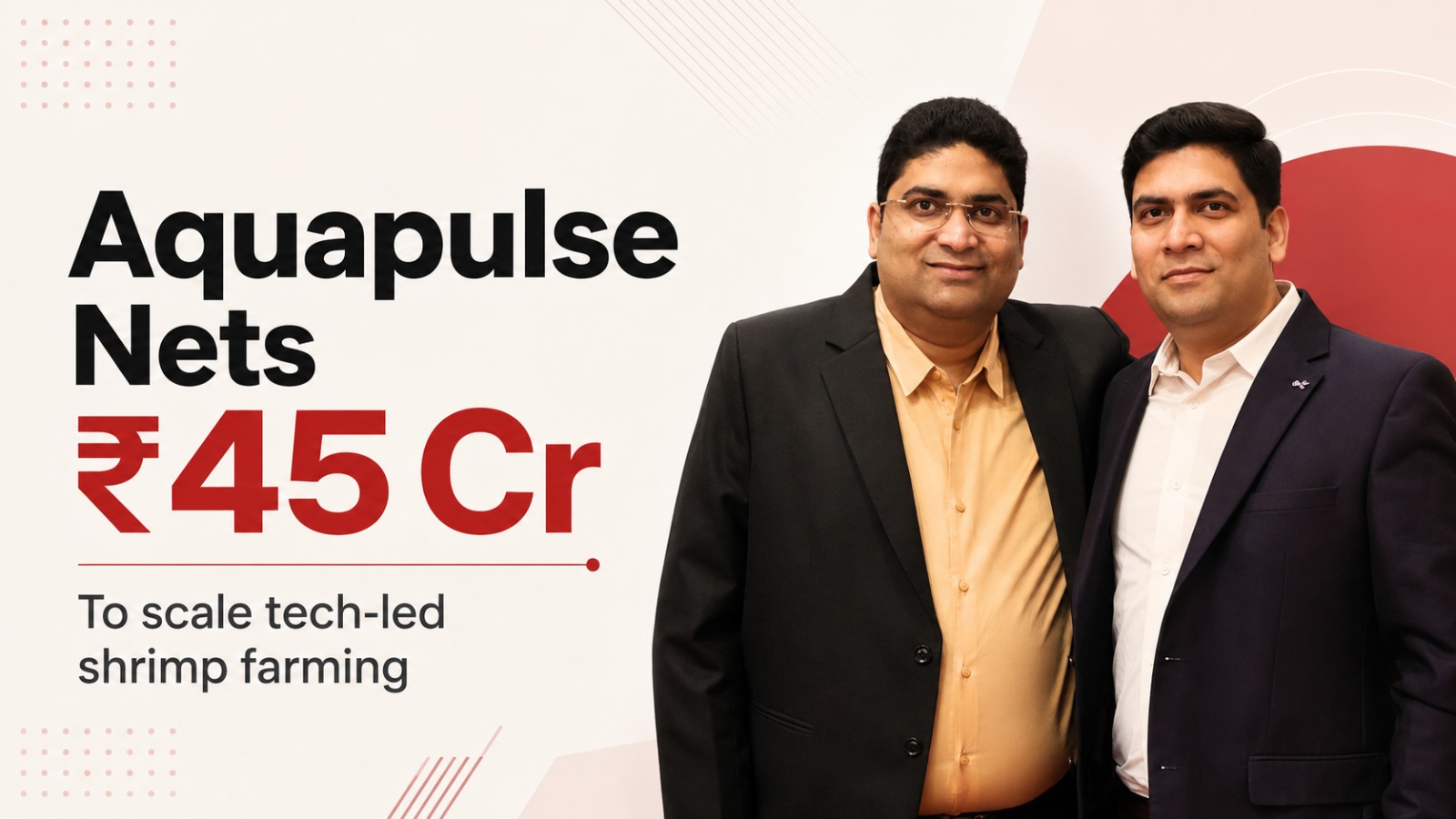
Bhubaneswar-based aquaculture technology and seafood export startup Aquapulse has raised ₹45 crore in a fresh funding round led by NABVENTURES, with participation from IAN Alpha Fund, as it looks to deepen its farm-level technology, expand procurement networks and strengthen export operations.
The round comes at a crucial moment for India’s seafood economy, where frozen shrimp continues to drive export earnings, but much of the farming base remains small, fragmented and underserved by formal market systems. Aquapulse is trying to solve that gap by building a more organised, traceable and farmer-linked supply chain that begins at the pond and ends with domestic and global buyers.
Founded in 2023 by Abhishek Dwivedy and Abhilash Dwivedy, Aquapulse works as a farmer-centric platform in India’s shrimp aquaculture sector. The startup currently operates across Odisha, Andhra Pradesh and West Bengal, using an aquapreneur-led hub-and-spoke model to work with shrimp farmers and improve productivity, traceability and market access.
Where the Fresh Capital Will Go
Aquapulse plans to use the new funding to strengthen farm-level technology, disease management systems and farmer procurement networks across eastern India. The capital will also be deployed to scale processing and export operations, while building working capital infrastructure for its growing global business.
The company’s model focuses on multiple points of the shrimp farming cycle. It supports farmers with water quality monitoring, feed management, disease early-warning systems and harvesting coordination. Beyond the farm, it connects pre-harvest technology support, lagoon-based harvesting, processing partnerships and export logistics into one traceable supply chain platform.
This pond-to-port approach is central to Aquapulse’s pitch. Instead of treating shrimp farmers as a loose supplier base, the company is attempting to build a structured network where production quality, traceability and buyer requirements are managed more closely.
“Aquapulse aims to bridge this gap through an integrated pond-to-port supply chain model. The capital helps us deepen the aquapreneur cluster model, strengthen pre-harvest technology at the pond and scale processing and exports,” said Abhishek Dwivedy, Co-founder, Managing Director and Chief Executive Officer. “We are not trying to replace the existing value chain overnight. We are trying to organise it, pond by pond, cluster by cluster, to ensure that quality, traceability and farmer income all move in the same direction.”
Making Small Farmers Visible in the Seafood Chain
A major part of Aquapulse’s story lies in how it wants to reposition the smallholder shrimp farmer within the export economy. In India’s aquaculture value chain, small farmers often remain invisible beyond the local procurement layer, even though their produce may eventually move into international markets.
Abhilash Dwivedy, Co-founder and Chief Growth Officer, said the company’s model is designed to address two challenges together: improving farmer incomes and ensuring consistent quality for international buyers.
“Our job is to make the smallholder shrimp farmer a named, recognised participant in the global seafood chain, not just an anonymous input,” he said.
That positioning matters because global seafood buyers are increasingly focused on consistency and traceability. For fragmented farming regions, this creates both pressure and opportunity. Aquapulse is betting that technology, cluster-level operations and organised procurement can help small farmers participate more meaningfully in this shift.
Investors Back Execution in a Complex Sector
The funding round was led by NABVENTURES, the venture capital arm of NABARD, through its AgriSURE Fund. IAN Alpha Fund also participated in the round.
For investors, Aquapulse appears to sit at the intersection of agriculture, exports, technology and supply chain formalisation. The company is not simply selling software to farmers. It is trying to build operating depth in a sector where quality control, disease risk, procurement, pricing and buyer access are closely linked.
Sarika Saxena, Managing Partner at IAN Alpha Fund, said Aquapulse stood out because of its understanding of the aquaculture ecosystem and its ground-level execution.
“We invest in scalable, execution-driven companies that bridge critical market gaps. Aquapulse stood out immediately due to their deep understanding of the aquaculture ecosystem and a ground-level operational model that drives genuine value for both vendors and customers,” she said.
Exports, Processing and the Road Ahead
Aquapulse operates under Phoenix Marine Exports and Solution Pvt Ltd and has emerged as one of the Odisha-based startups building a seafood export business around technology-enabled traceability and farmer aggregation. The company currently exports shrimp primarily to China, Vietnam and Japan, while also serving domestic institutional buyers and modern retail channels.
The startup has now raised a total of ₹70 crore in the last two months. In April, it raised ₹25 crore for expansion, setting up an in-house processing facility and strengthening its technology stack. The company is also investing in AI-led pre-harvest and post-harvest systems, along with a tech-led transparent pricing model.
The exports of seafood in India amounted to nearly 1.97 million metric tonnes during FY26, with a valuation exceeding ₹73,890 crore, with frozen shrimps still leading in export earnings. Within this context, it is important to note that the expansion strategy adopted by Aquapulse is part of an overarching trend within the industry of moving towards a more organized approach.
For Aquapulse, the next phase will depend on how effectively it can scale its aquapreneur cluster model while maintaining quality, farmer trust and export reliability. The opportunity is large, but the execution challenge is equally real. In a sector where disease risk, pricing volatility and supply consistency can decide margins, the company’s real test will be whether its pond-to-port model can deliver at scale without losing the farmer-first promise at its core.
Also Read: Vaibhav Suryavanshi’s Rise Is Bigger Than a Net-Worth Number
















