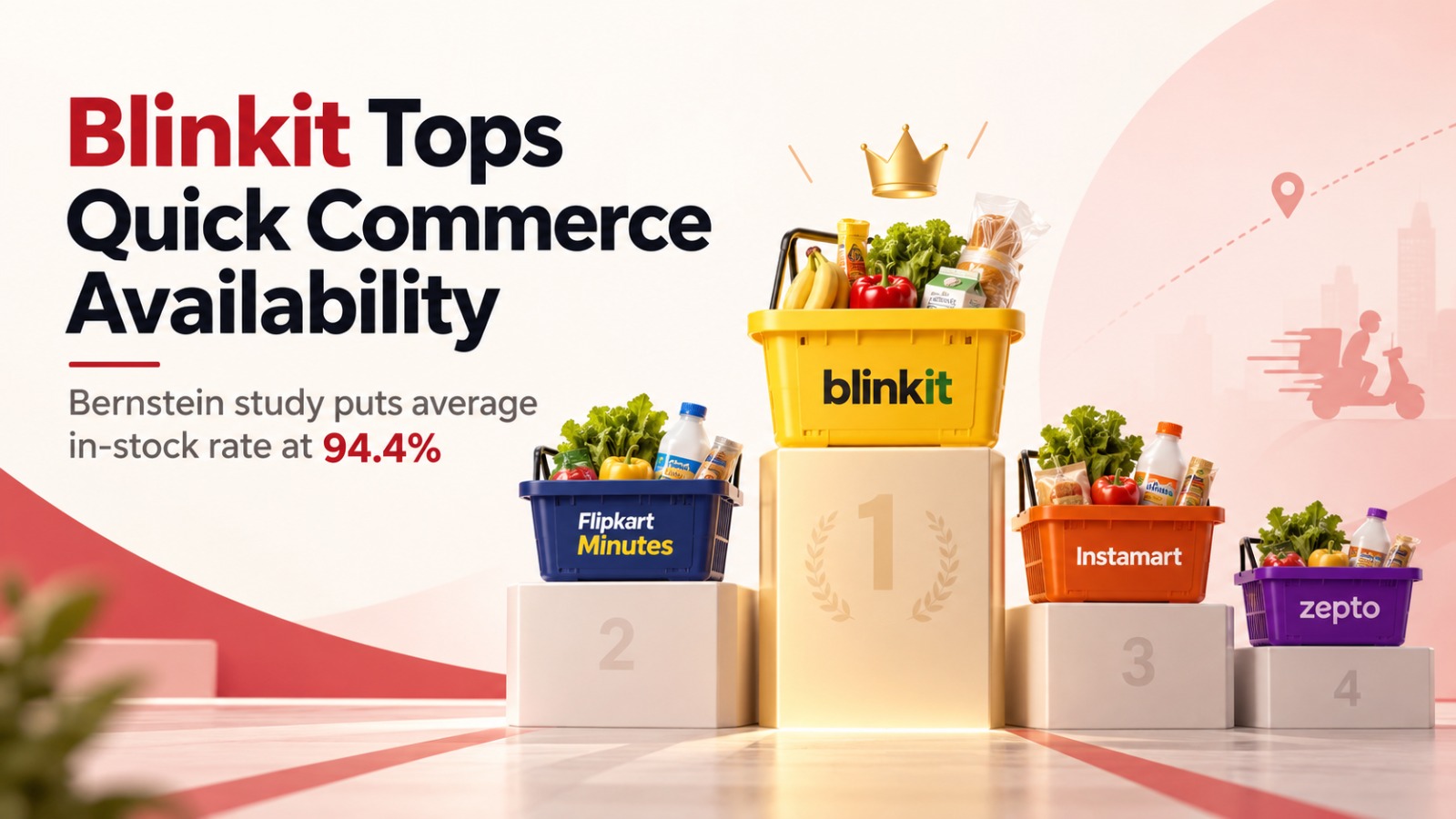
Blinkit has emerged as the strongest performer in product availability among four major Indian quick commerce platforms, recording an average in-stock rate of 94.4%, according to a study by brokerage firm Bernstein.
The findings put Flipkart Minutes in second place, highlighting how inventory reliability is becoming an important competitive factor alongside delivery speed and pricing.
Flipkart Minutes recorded an availability rate of 88.7%, followed by Swiggy Instamart at 83.8% and Zepto at 82.5%.

The results indicate a 5.7-percentage-point gap between Blinkit and its nearest competitor, while the difference between the highest- and lowest-ranked platforms reached 11.9 percentage points.
The study offers a closer look at a key operational challenge for quick commerce companies: ensuring that products remain available for purchase throughout the day, particularly as consumer orders affect inventory levels.
Bernstein Study Covers 150 Products Across Three Cities
Bernstein evaluated product availability across 150 stock-keeping units (SKUs), including groceries, fresh products and non-grocery essentials.
The assessment covered 10 days, with availability checked across seven time slots daily in three PIN codes each in Mumbai, Gurugram and Bengaluru.
The research focused on whether selected products were available on the platforms during the observation periods, rather than comparing delivery times or the total number of products listed.
Blinkit maintained relatively stable stock availability of approximately 94% to 95% throughout the study.
In comparison, Instamart and Zepto experienced greater fluctuations, with availability falling below 80% during certain observation periods.
Zepto Records Sharpest Decline in Availability During the Day
The study also examined how product availability changed as the day progressed, revealing differences in inventory management among the platforms.
Zepto recorded the sharpest decline in availability at 11%, while Blinkit and Flipkart Minutes registered the smallest declines at 5% each.
Bernstein attributed Instamart’s relatively higher decline to potential challenges involving demand forecasting and inventory replenishment.
For quick commerce operators, maintaining availability requires coordination between demand prediction, procurement, dark-store inventory and replenishment schedules.
A product that is available in the morning may become unavailable later if incoming stock fails to keep pace with orders.
The variation identified in Bernstein’s research therefore highlights the importance of inventory planning in a business where customers expect rapid fulfilment.
Why Product Availability Matters in Quick Commerce
India’s quick commerce platforms have traditionally competed through delivery speed, discounts and product selection. However, Bernstein’s findings point to stock availability as another area of operational differentiation.
For consumers, fast delivery offers limited value if essential items are unavailable when placing an order.
This becomes particularly relevant when shoppers want to purchase several products together. Missing items can force customers to modify their baskets, choose substitutes or place orders through competing platforms.
Bernstein believes Blinkit’s stronger inventory performance could support customer retention and reduce churn by enabling more complete shopping baskets.
However, the study does not establish whether higher product availability has already translated into stronger customer loyalty, larger orders or increased profitability.
It measures availability within a defined sample and observation period, rather than overall consumer satisfaction or market leadership.
Inventory Strategies Add Context to Financial Comparisons
The findings also come amid differences in how major quick commerce businesses manage inventory and recognise revenue.
Blinkit and Zepto follow inventory-led operating models, while Swiggy Instamart primarily uses a marketplace model, according to the reported comparison.
The report cited revenue of Rs 15,664 crore for Blinkit in the first quarter of FY27 and Rs 22,624 crore for Zepto for a separately referenced reporting period.
What the Findings Mean for India’s Quick Commerce Market
Bernstein’s analysis points to a competitive dimension that may become increasingly relevant as quick commerce platforms expand their product offerings.
To ensure availability in the categories of groceries, fresh, and non-groceries, it is not just about carrying a broad range of stock but also forecasting needs in specific stores and refilling stocks before popular items get exhausted.
Blinkit’s performance in the study suggests greater consistency in maintaining the availability of the selected products across the locations and time slots examined.
Flipkart Minutes’ second-place ranking also positions it ahead of Instamart and Zepto on this particular measure, although the findings cannot establish whether the same ranking holds across the platforms’ wider networks.
The research was limited to 150 SKUs and selected PIN codes in three metropolitan markets. Product availability in other cities, neighbourhoods, categories or periods may differ.
Nevertheless, the findings underline a practical distinction in the quick commerce experience: delivery speed matters, but so does having the products customers want in stock when they place an order.
For India’s quick commerce operators, consistently fulfilling customer baskets could prove an important area of competition alongside pricing, selection and delivery performance.
Also Read: GPT6 Is Here: What Can You Do With OpenAI’s New Intelligent UI?