

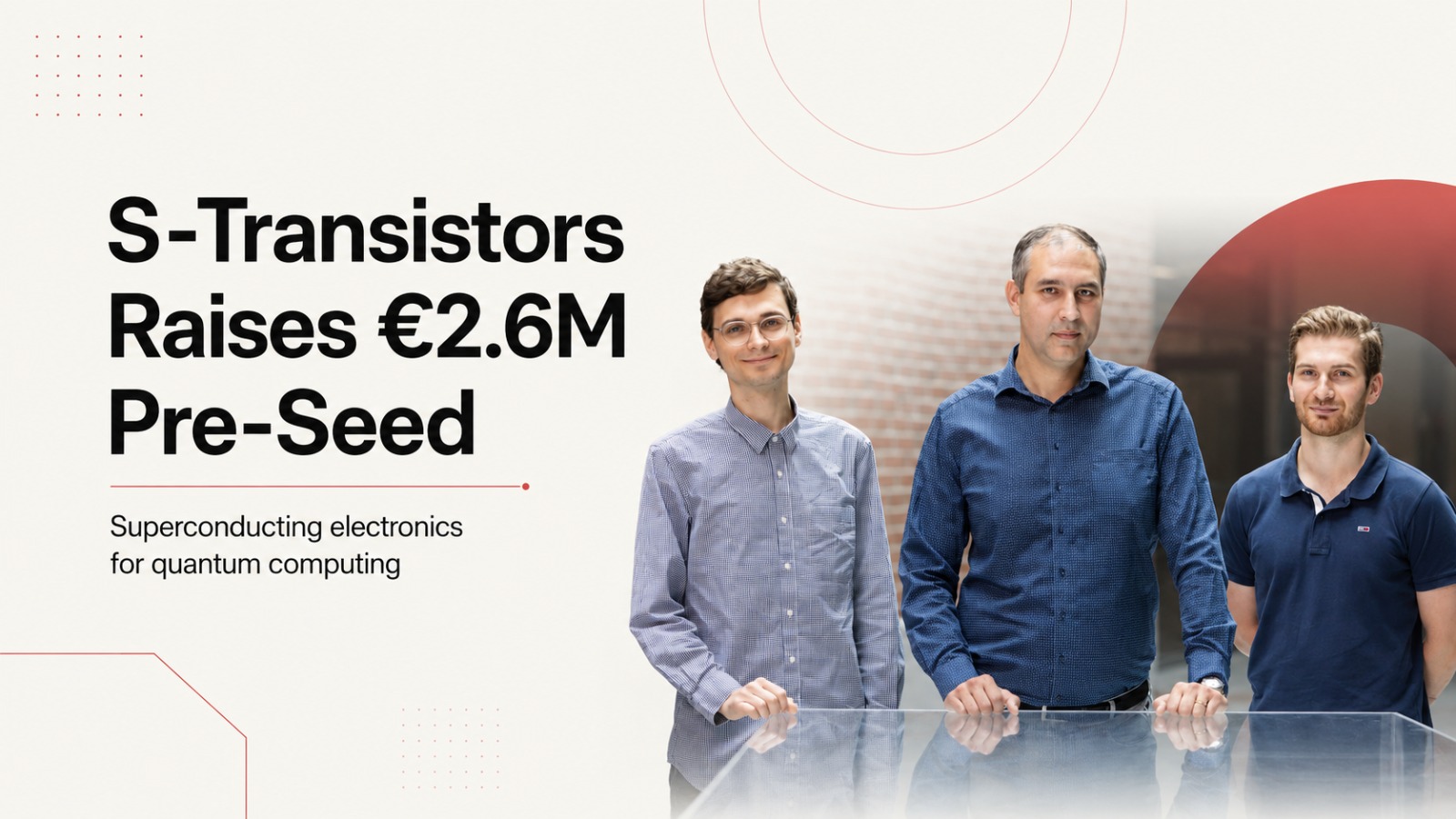
Finnish deeptech startup S Transistors has raised €2.6 million in pre-seed funding, with the round led by Lifeline Ventures and joined by an angel investor. The company plans to use the capital to move its superconducting transistor technology closer to practical deployment in quantum computing.
Spun out of VTT Technical Research Centre of Finland, S-Transistors is developing integrated circuits built around superconducting transistors. Its immediate focus is a problem that becomes increasingly difficult as superconducting quantum computers grow: how to control and route signals to large numbers of qubits without relying on an expanding network of power-hungry electronics and cables operating outside the cryogenic system.
The startup’s approach is to bring more of that classical control and interface hardware closer to the quantum processor itself, where temperatures are extremely low. Conventional electronics can become difficult to use efficiently in such an environment because heat generation has to be kept under tight control.
According to the company, today’s systems can require multiple bulky cables for individual qubits, connecting processors inside the cryostat to electronics at room temperature. S-Transistors believes superconducting transistors can provide a more compact and energy-efficient alternative for handling those signals. Its technology is already available at wafer scale.
Funding to move from devices to working cryogenic hardware
The new financing is intended to fund more than continued research.
S-Transistors plans to develop several prototypes for cryogenic signal control and handling, establish its own cryogenic laboratory, create a pilot manufacturing line for its superconducting-transistor integrated circuits and expand its team.
That manufacturing component is central to the company’s next stage. S-Transistors is positioning itself not simply around a laboratory demonstration, but around turning the underlying transistor technology into circuits that can be tested and used by customers.
Co-founder and CEO Dr. Heorhii Bohuslavskyi said the challenge facing superconducting quantum computers is increasingly tied to their supporting electronics. While progress has been made in scaling quantum systems, he argued that continuing to depend on room-temperature control equipment and separate wiring for individual qubits creates a major constraint.
The company’s proposed answer is to place more of the control layer inside the cryostat, close to the quantum chip. Doing so, however, demands electronics capable of combining speed with exceptionally low power dissipation. S-Transistors sees superconducting transistors as the hardware needed to meet those requirements.
A multiplexer comes first
Rather than beginning with a complete new computing architecture, S-Transistors is starting with a more focused product.
Its first commercial target is a superconducting-transistor-based multiplexer designed to plug into existing cryogenic systems and assist with the development and prototyping of quantum devices.
The company plans to deliver the multiplexer to early customers and strategic partners within its first year of operation. S-Transistors describes the device as an initial step toward a much broader ambition: creating what it calls a “quantum motherboard” for controlling increasingly large quantum processors at millikelvin temperatures.
That sequence gives the startup a relatively clear path from platform technology to an initial product. The multiplexer addresses signal routing first, while the longer-term architecture would bring a larger share of the supporting electronics into the same extremely cold environment as the quantum-processing unit.
Why control electronics matter as qubit counts rise
The opportunity S-Transistors is pursuing sits outside the qubits themselves.
As quantum processors become larger, the infrastructure required to operate them also has to scale. Control electronics must send instructions to the processor and carry signals back out, while producing little enough heat to preserve the cryogenic conditions required by the system.
Some silicon transistors can function at deep cryogenic temperatures, but S-Transistors says they face difficulties in simultaneously delivering the performance and low power consumption required to control very large numbers of qubits. Excess heat inside the system can interfere with the environment needed for quantum operations.
Dr. Andrey Generalov, co-founder and CTO of S Transistors, sees the longer-term opportunity in combining transistor functionality with superconducting properties to build much more energy-efficient cryogenic computing electronics.
Investor Lifeline Ventures is backing that thesis. Partner Jyri Engeström said the technology could eventually become an enabling part of the quantum-computing hardware stack as machines move toward larger qubit counts.
Beyond quantum computing
S-Transistors is starting with quantum computing, but the company sees possible applications for superconducting transistor technology beyond that market.
Potential areas identified by the company include classical computing, artificial intelligence and high-performance computing hardware, spacecraft electronics and fundamental particle detectors. Its stated objective is to move the technology from laboratory development toward manufacturing and customer adoption.
For now, the milestones are more immediate: build the cryogenic lab, establish pilot manufacturing, turn the technology into working signal-control prototypes and place the first multiplexers with users.
The €2.6 million pre-seed round gives S-Transistors the capital to begin that transition from a VTT spinout built around superconducting transistor technology to a company attempting to manufacture and deliver cryogenic electronics for the quantum-computing industry.
Also Read: Paleo Raises $2.3M After 613-Fold Cost Cut
















