

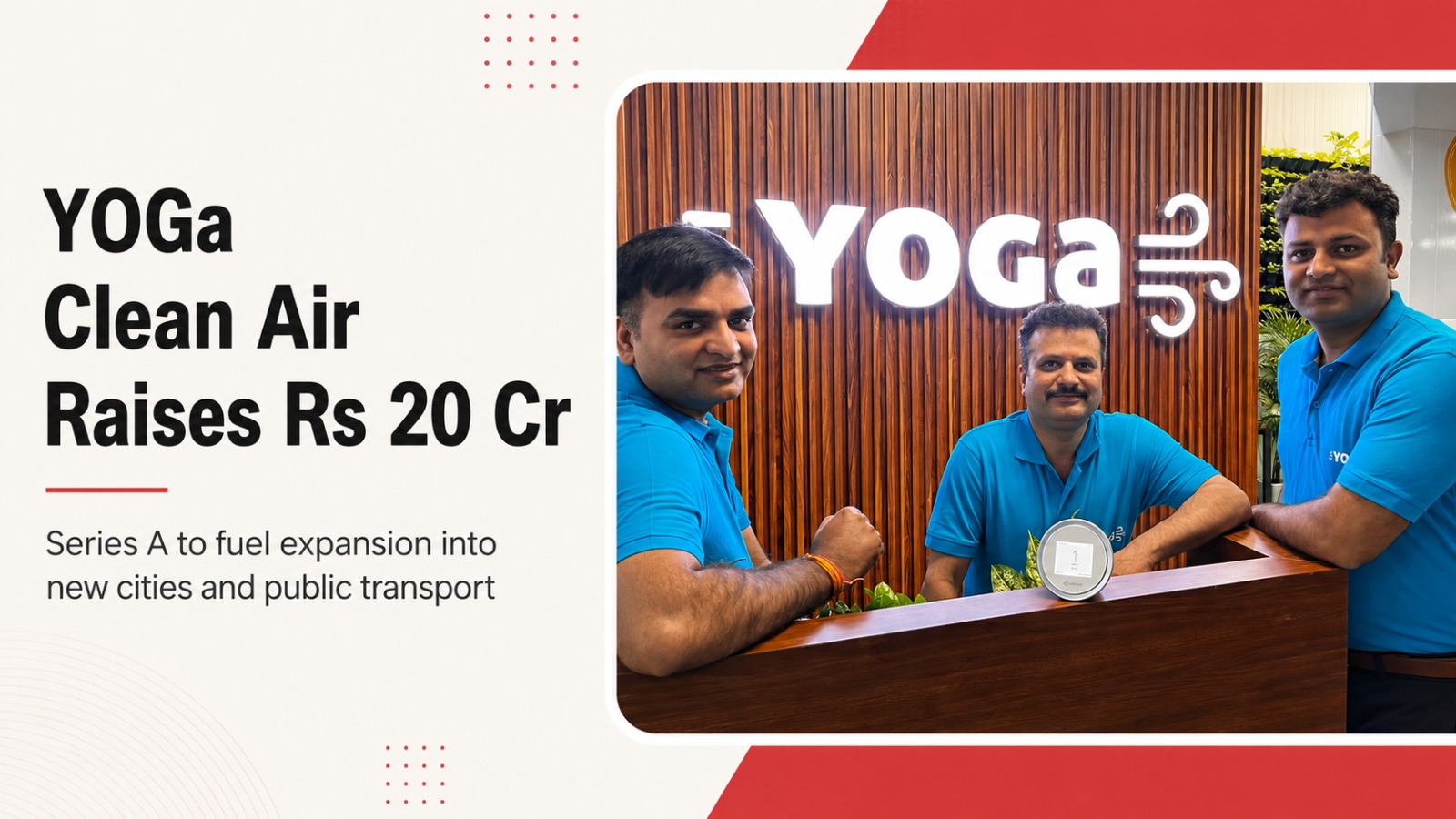
Clean-air technology startup YOGa Clean Air has raised Rs 20 crore in a Series A funding round, giving the company fresh capital to expand its footprint and take its systems into new use cases, including public transport.
The round was led by Info Edge Ventures, with participation from Deepinder Goyal, founder of Zomato parent Eternal, and Three Words. YOGa Clean Air plans to use the capital to strengthen its presence in markets where it already operates, expand into additional Tier-1 and Tier-2 cities, and deploy its systems in public transport and other environments.
For YOGa Clean Air, the funding comes at a stage when the company is looking to move beyond its existing base of homes and institutional customers and test how its technology can work across a wider set of environments.
YOGa Clean Air is building around pressure-controlled clean air
Founded in 2019 by Sachin Panwar, Deepak Raina and Gaurav Nagar, YOGa Clean Air has developed a patented clean-air system that works by filtering incoming air while maintaining slightly higher air pressure inside a space.
The idea is to reduce the entry of polluted outside air rather than relying only on purification after pollutants have already entered an indoor environment. The system also manages carbon dioxide levels as part of its approach to indoor air quality.
That distinction is central to the company’s product proposition. Instead of positioning its offering simply as another room-based air purifier, YOGa Clean Air is building systems intended to manage the quality of air entering and circulating within an enclosed space.
Its planned move into public transport could widen that use case further, taking the technology into environments where air quality has to be managed for larger numbers of people and across more dynamic operating conditions.
More than 5,000 families and institutions already use its systems
YOGa Clean Air says its technology currently serves more than 5,000 families and institutions across 11 Indian cities.
Its customer base includes hospitals, schools, offices and gyms, while its presence spans cities including Delhi-NCR, Mumbai, Kolkata, Bengaluru and Hyderabad. The company also holds two patents covering its technology.
The startup has also reported strong performance from some of its installations. According to the company, its systems have reduced indoor air pollution to single-digit levels even when outdoor pollution exceeded 900 µg/m³, while also keeping carbon dioxide levels under control. These figures are company claims and should be read as such.
The existing footprint gives YOGa Clean Air a base from which to pursue the next phase of growth. Rather than concentrating only on one customer category, the startup has already deployed its systems across residential, healthcare, education, workplace and fitness environments.
Fresh capital to widen the footprint
The Series A capital will now be directed largely towards expansion.
YOGa Clean Air intends to deepen its presence in cities where it already operates while entering more Tier-1 and Tier-2 markets. At the same time, the company plans to take its technology into public transport and other environments, widening the scope of where its clean-air systems can be deployed.
That makes the next phase of YOGa Clean Air’s journey as much about expanding applications as expanding geography.
The company has so far built its business around managing indoor air quality in homes and institutions. With the latest capital, it is preparing to test whether the same underlying approach can be applied across a broader range of enclosed spaces.
For YOGa Clean Air, the Rs 20 crore Series A is therefore not only a funding milestone. It marks a push to take a patented clean-air system that has already found users across 11 cities into new markets and potentially very different operating environments.
Also Read: How Did 40,000 Pounds of Pabst Blue Ribbon Beer Disappear in One Morning?
















