

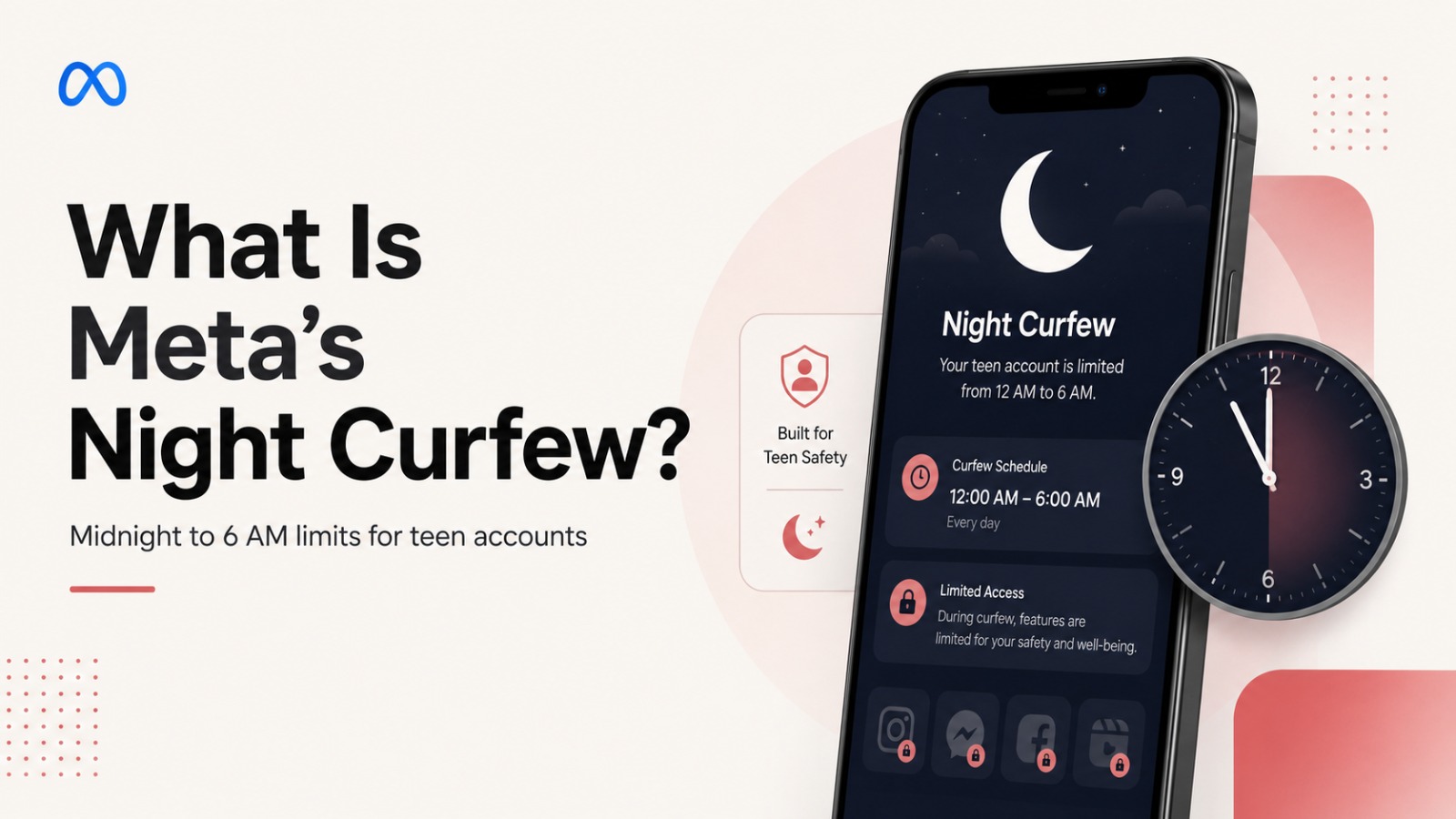
Meta’s proposed “night curfew” would automatically restrict teenage users from accessing most of Facebook and Instagram for six hours every night, with a separate overnight notification shutdown and a two-hour daily usage limit also forming part of the plan.
Meta has agreed to a sweeping set of proposed restrictions for teenage users of Facebook and Instagram, including what amounts to a nightly curfew on access to the two platforms.
The plan forms part of a proposed settlement with US states over allegations that Meta’s platforms were designed in ways that encouraged excessive and potentially harmful use among children. Crucially, the settlement still needs approval from a judge, meaning the restrictions are not yet final.
Among the changes, the nighttime restriction stands out because it would go beyond simply muting notifications. Teenagers would be unable to access most Facebook and Instagram features for a fixed period every night.
What exactly is Meta’s night curfew?
Under the proposed settlement, teenage accounts would face a default block on most Facebook and Instagram features between midnight and 6 am local time.
The restriction would have to be introduced within six months after the settlement takes effect.
Messaging and account settings would remain available in a limited form during the curfew period. However, teenagers would not be able to use those functions as a route back into the wider Facebook or Instagram experience.
That distinction is important. This is not simply a reminder telling teenagers that they have been online for too long. For most parts of the platforms, access itself would be restricted during the six-hour window.
Meta would also shut off push notifications for teen accounts between 10 pm and 7 am, creating a longer period in which Facebook and Instagram alerts would not appear on users’ devices.
Teenagers could also get a two-hour daily limit
The nighttime curfew would sit alongside another major restriction: a default two-hour cumulative daily usage allowance across Facebook and Instagram.
The allowance would reset at midnight. Teenagers would not be able to change the limit themselves without parental approval, while parents would have the option to impose tighter restrictions.
Not every activity would count towards those two hours. The proposed terms exclude certain uses, including messaging and long-form video, from the daily allowance.
The structure therefore separates different types of activity rather than applying a simple two-hour shutdown to everything a teenager does across Facebook and Instagram.
The curfew could become longer
The proposed rules also contain a provision linked to competing platforms.
If services including TikTok and YouTube introduce equivalent protections, the restrictions on Meta’s platforms could become tougher. In that situation, the overnight block could be extended from 10 pm to 7 am, while the daily usage allowance could also be reduced.
That means the midnight-to-6 am curfew described in the initial proposal may not necessarily represent the strictest version of the system.
Notifications would stop during school hours too
Meta’s proposed restrictions would extend into the school day.
Notifications for teenage accounts would be switched off from 8 am to 3 pm on weekdays during the defined school year. The measure is intended to reduce interruptions while students are in school.
Parents would also receive daily information showing how much time their teenagers have spent using the platforms.
Taken together, the proposal creates three separate periods of control: a nighttime access restriction, an overnight notification blackout and a school-hours notification pause.
Instagram and Facebook feeds could change for teens
The settlement is not limited to screen-time controls.
Within four months, teenage users would be offered the option of a non-personalised feed, giving them an alternative to algorithmically curated content.
Like and reaction counts would be hidden by default for teenagers. Certain filters linked to cosmetic surgery would also be prohibited for teen users.
These measures would change both how long teenagers can access Meta’s platforms and parts of what they see while using them.
Meta would have to strengthen age checks
The restrictions would depend heavily on Meta being able to determine which accounts belong to teenagers.
The company would have one year to introduce a more accurate age-assurance system. It would also be required to improve its ability to identify teenagers who enter an older age while creating an account.
If the age of a new user cannot be verified within 14 days, the account would be treated as a teen account regardless of the age entered during registration.
This provision could be significant because the curfew and daily limits would have little practical effect if teenage users could easily avoid being classified as teenagers.
Also Read: Why Meta Is Paying Up to $16.68 Billion in Teen Safety Lawsuit?
Parents would get more direct control
Parental supervision is another major part of the proposal.
Parents supervising a teen account would receive daily usage information, reminders to review account settings and the ability to adjust restrictions connected with school hours.
The approach puts many of the protections on by default rather than requiring teenagers or their parents to discover and activate individual safety tools themselves.
Parents could also tighten some restrictions beyond Meta’s default settings.
Meta could face 10 years of outside monitoring
Compliance would not be left entirely to Meta.
An independent auditor, selected jointly by Meta and a committee representing the states, would monitor the company’s compliance with the settlement for 10 years.
Meta would also be prohibited from making false or misleading statements about its safety features.
The financial component of the proposed agreement could reach up to $16.7 billion, with the amount depending in part on whether rival platforms adopt comparable measures. Payments would be made annually over a decade under the proposed arrangement.
What the Meta night curfew would mean in practice
If approved in its current form, a teenager using Facebook or Instagram late at night would encounter something quite different from today’s voluntary screen-time prompts.
Most platform features would become unavailable at midnight and remain restricted until 6 am. Notifications would already have stopped two hours earlier, at 10 pm. During the daytime, the teenager would also be working within a two-hour cumulative allowance for eligible Facebook and Instagram activity, while school-day notifications would remain silent from 8 am to 3 pm.
The most significant change is therefore not one individual timer. It is the combination of access limits, notification controls, parental oversight, age verification and changes to how teen feeds operate.
For now, however, these remain proposed measures rather than active rules. Their implementation depends on judicial approval of the settlement.
Also Read: iPhone 18 Pro: What’s Getting More Expensive Before the Launch?

















