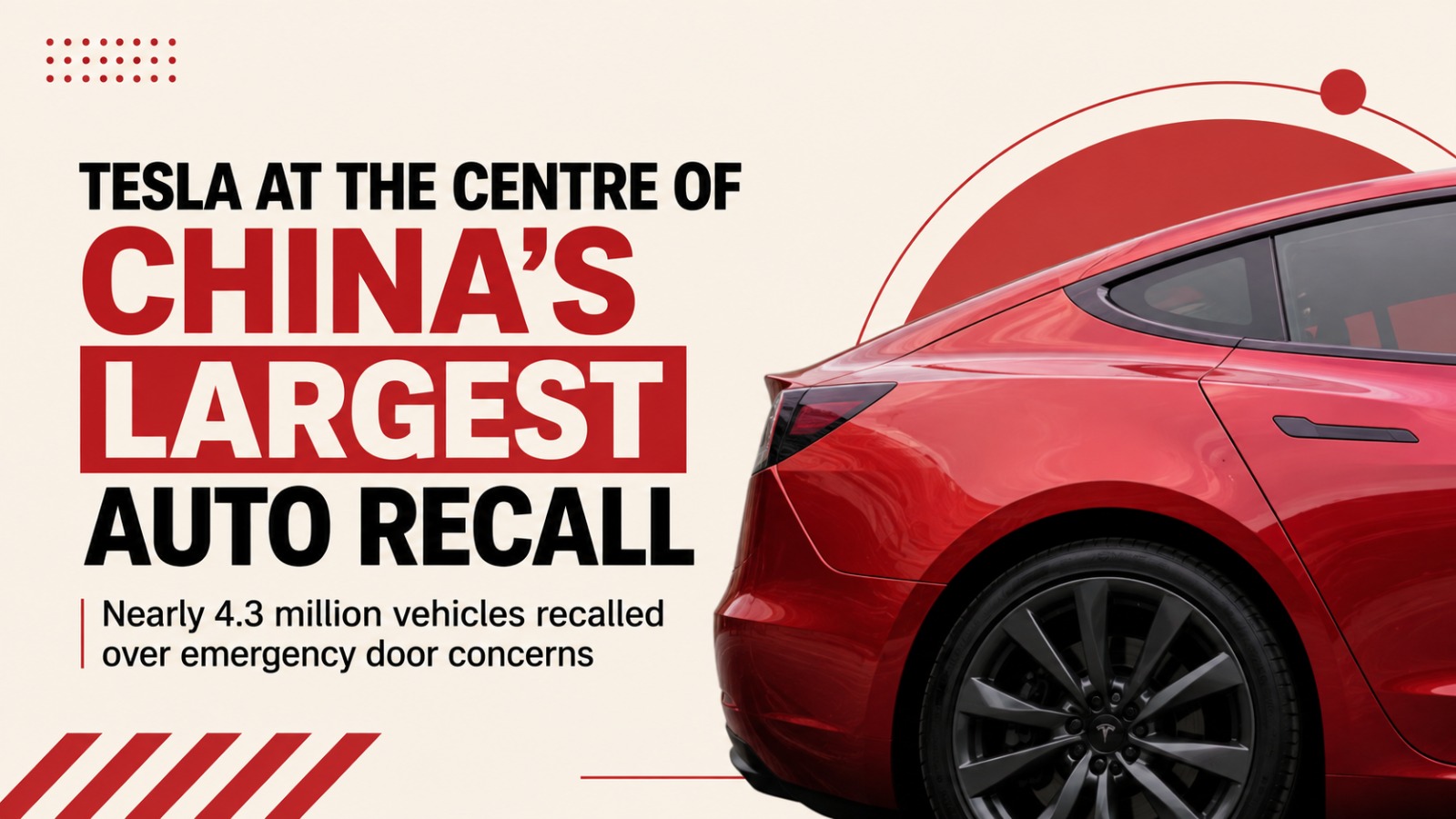
Tesla is at the centre of China’s largest automotive recall to date, with the company and 10 other automakers recalling nearly 4.3 million vehicles over concerns that occupants may have difficulty opening doors during an emergency. The recalls focus mainly on emergency door-release systems that could be difficult to identify or operate after a serious crash, particularly if the vehicle’s electrical system is damaged.
The recall campaign comes as Chinese authorities increase scrutiny of vehicle safety and introduce stricter requirements for new-energy vehicles. The measures announced by the affected manufacturers include software updates, warning labels and improvements to the visibility of emergency door-release mechanisms.
Safety concerns put hidden door handles under the spotlight
The issue centres on emergency mechanical door releases used in vehicles with electronic or concealed exterior door handles. In a severe collision, damage to the vehicle’s low-voltage electrical system could make the electronic door-opening system unavailable. Regulators have raised concerns that occupants might then struggle to locate or operate the mechanical release, while rescuers outside could also face difficulties accessing the vehicle.
The safety debate has gained greater attention following incidents involving vehicles that caught fire after crashes. Chinese authorities have subsequently moved toward tighter rules for concealed door-handle designs. China has announced that concealed door handles will be prohibited for new vehicle models from 2027, making it the first country to phase out the design.
Also Read: Is Tesla Turning Away From Electric Cars? Model S and X Production Set to End
Tesla’s recall covers nearly 3 million vehicles
Tesla accounts for the largest share of the recall campaign. The company will recall about 2.98 million China-made and imported Model 3, Model Y, Model S and Model X vehicles, with the recall scheduled to take effect on September 25, 2026.
China’s State Administration for Market Regulation said the emergency mechanical door-release handles on the affected vehicles may be difficult to identify following a severe collision and electrical system failure. Tesla’s corrective measures include adding warning labels and deploying an over-the-air software update that is designed to lower the vehicle windows after a collision.
The window-control update is intended to provide another way for occupants or rescuers to gain access after a crash when the normal electronic door-opening system may not function.
Xiaomi, Leapmotor and Xpeng join the recall
Tesla is not the only manufacturer affected. Xiaomi is recalling approximately 390,000 vehicles, while Leapmotor’s campaign covers about 371,000 vehicles. Xpeng is recalling around 265,000 vehicles. Geely and several other manufacturers are also involved in the broader recall action.
The corrective measures vary between manufacturers. Xiaomi’s recall includes warning labels and software changes related to unlocking and post-crash window operation. Leapmotor is using warning labels and a power-window software update, while Xpeng’s announced remedy includes warning labels for affected vehicles.
The scale of the campaign reflects a broader effort to address emergency access concerns across several vehicle brands rather than a problem limited to a single manufacturer.
China moves toward stricter door-handle rules
The recalls come as China prepares tougher requirements for vehicle door designs. The country’s new safety standards are aimed at ensuring vehicles have mechanical ways to open their doors, reducing reliance on electronic systems in emergency situations. The new requirements are scheduled to apply to new models from January 1, 2027.
Concealed door handles became increasingly common in electric vehicles as manufacturers adopted cleaner exterior designs and more technology-driven features. Tesla helped popularise the design, which was later adopted by several Chinese EV makers. The latest recall campaign has placed greater focus on whether such systems can provide a reliable escape route when a vehicle loses electrical power.
Door-handle safety also draws US attention
Concerns over electronic and concealed door handles are not limited to China. US regulators are also examining the potential risk of occupants becoming trapped when electrical power is lost after a crash. The National Highway Traffic Safety Administration has been considering safety requirements addressing emergency access to vehicles with these systems.
However, the US has not announced a recall matching the large-scale action now taking place in China. The Chinese campaign therefore represents a major regulatory response to concerns surrounding emergency door access and the growing use of electronic features in modern vehicles.
Also Read: Tesla Said These 5 Seconds of Autopilot Crash Data Weren’t Available. Then a Hacker Recovered Them