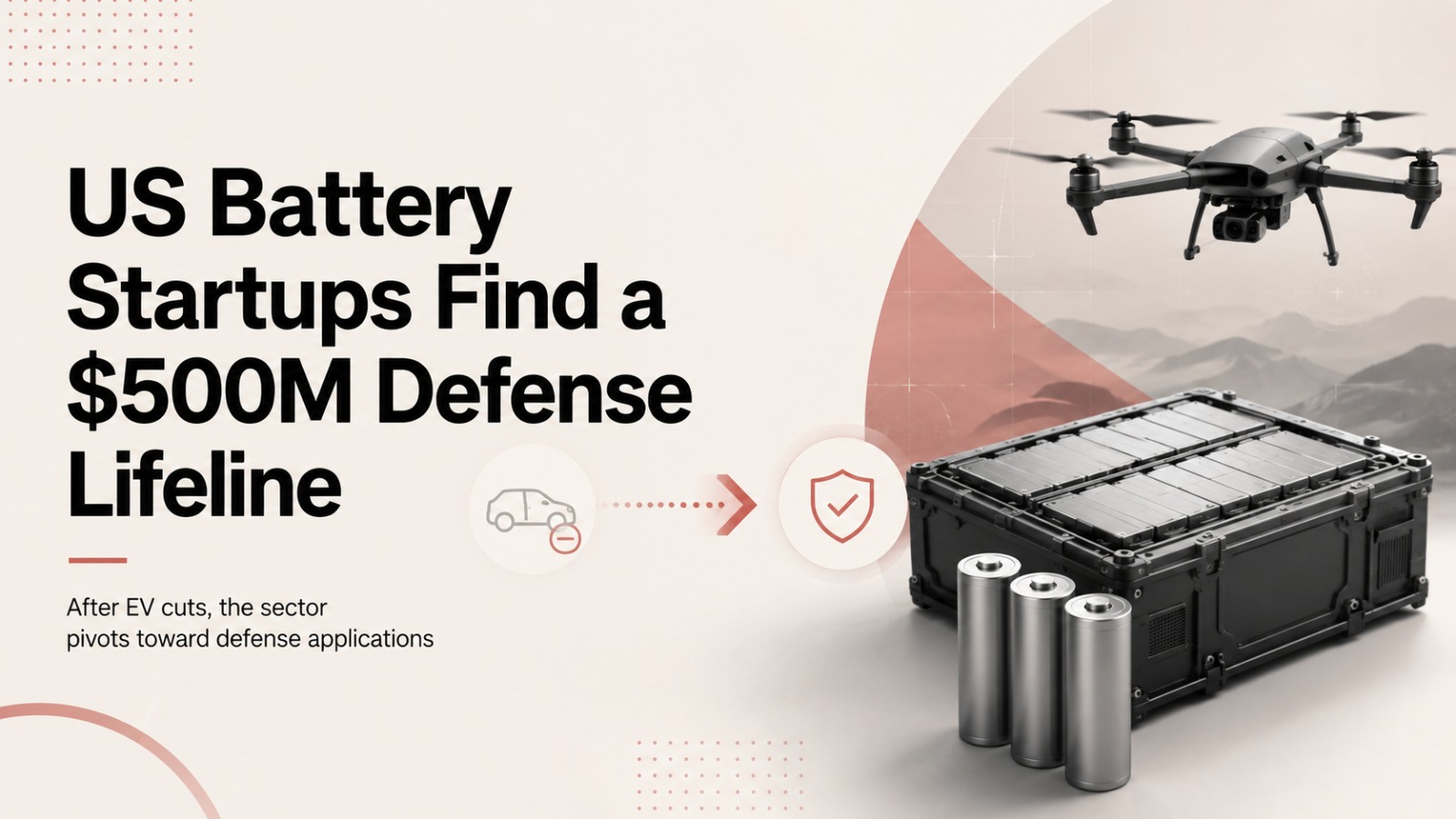
The U.S. battery startups are finding a new source of support outside the consumer electric vehicle market.
The Department of Energy has announced $500 million in grants for U.S. battery startups focused on defense applications, giving companies another route to commercialise battery technologies as the industry adjusts to a more difficult environment for EV-focused businesses.
The funding represents more than a fresh pool of government capital. It also points to a change in where some battery companies may see their next customers.
For years, much of the sector’s commercial story revolved around electric vehicles, charging, driving range and the prospect of mass-market adoption. The new emphasis is different. Defense applications bring requirements ranging from high energy density for drones to portable power systems for field operations and batteries designed to perform reliably under demanding conditions.
That shift is already changing how some companies present their technology. Instead of building a pitch primarily around consumer EV performance, startups are increasingly highlighting military uses, resilient domestic supply chains and the ability to support equipment that depends on reliable power away from conventional infrastructure.
The Significance
The funding comes after reductions in federal EV incentives placed additional strain on battery companies whose business expectations had been tied closely to continued growth in the electric vehicle market.
That matters because developing advanced batteries is expensive, while turning laboratory improvements into commercially viable products can require significant capital and time.
Defense applications offer a different commercial path. Batteries used in military settings may be expected to withstand extreme temperatures, repeated charging cycles and situations where reliability is critical. Those requirements can create opportunities for technologies that may have been difficult to sell into highly price-sensitive consumer markets.
The information available does not identify individual grant recipients or provide a company-by-company breakdown of the $500 million allocation.
From EV specifications to military requirements
The most striking part of the transition may be how little the underlying ambition has changed even as the target market has.
Battery startups are still trying to improve energy storage, charging performance, durability and energy density. What is changing is the use case.
A technology once promoted in terms of extending vehicle range could instead be positioned around keeping a drone in the air longer. A battery designed around mobility could be adapted for portable field equipment. Supply-chain arguments that once centred on building a domestic EV industry can also be framed around reducing dependence on overseas components for strategically important equipment.
That makes the defense opportunity more than a simple change in marketing. It could influence which technical characteristics companies prioritise, how products are tested and which customers they design for.
Domestic battery production takes on a security dimension
The funding also reflects the growing importance attached to maintaining battery manufacturing capacity inside the United States.
Battery production depends on supply chains that include lithium, cobalt and rare earth materials. Concerns over dependence on China for important parts of those supply chains have added a national security dimension to what was previously discussed largely as an industrial and clean-energy challenge.
In that context, keeping battery development and manufacturing capacity in the U.S. can serve multiple objectives at once. It can preserve industrial capability, support advanced energy-storage development and provide technologies that could eventually be used in defense systems.
The $500 million initiative therefore arrives at a moment when battery technology is being viewed through a broader lens than electric cars alone.
Defense funding brings a different set of challenges
A move toward military customers does not automatically solve the commercial problems facing battery startups.
Defense procurement can involve extensive testing, qualification requirements, security procedures and long purchasing cycles. Companies accustomed to moving quickly from product development to commercial deployment may have to operate on very different timelines when selling into the defense sector.
That creates an important question for startups receiving or pursuing government-backed opportunities: whether they can survive long enough to turn technical promise into recurring defense revenue.
The funding can provide companies with additional time to adapt technologies, modify production and pursue new customers. But the durability of that transition will depend on what happens after the grant money is deployed.
What the shift could mean for consumer battery innovation
The move also raises a broader issue for the industry.
If more engineering resources and investment begin flowing toward military specifications, some development work that might otherwise have gone into lower-cost or faster-charging consumer batteries could move with it.
That does not mean consumer battery development will stop. The information available does not support such a conclusion. It does, however, show that defense applications are becoming a more visible commercial option for an industry that had previously been heavily associated with the EV boom.
For battery startups, that distinction could be significant.
The next phase of the U.S. battery market may not be defined solely by how many electric cars reach the road. It may also be shaped by drones, portable military power systems, domestic manufacturing capacity and the strategic value Washington places on having advanced battery technology produced closer to home.
The $500 million Department of Energy funding programme gives companies another route forward. Whether that route develops into a lasting business model will depend on how effectively battery startups can translate technology created during the EV expansion into products that meet the very different demands of defense customers.
Also Read: Anthropic IPO Could Top SpaceX as Biggest IPO in History: Reports