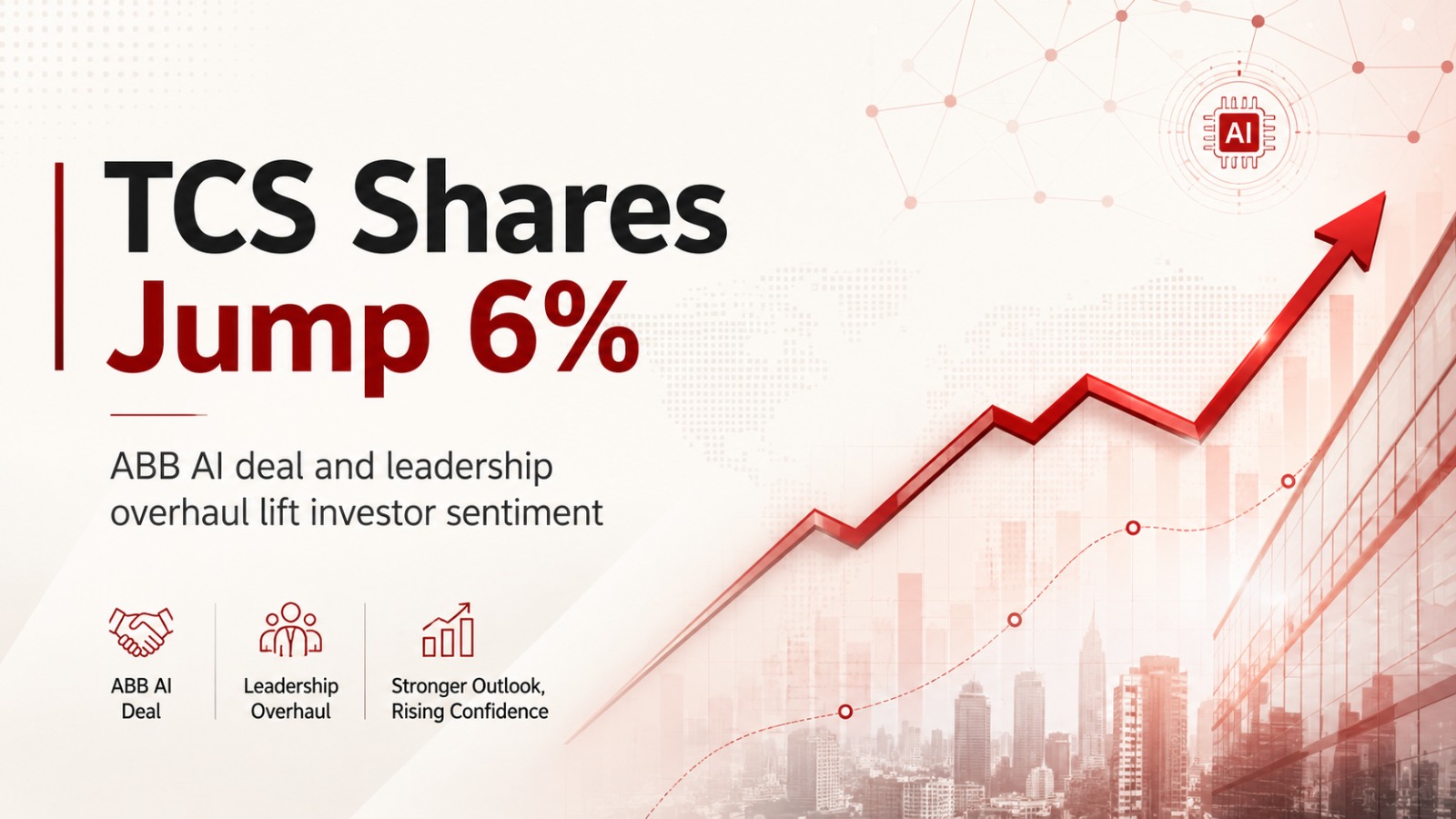
TCS shares climbed nearly 6% on July 13, 2026, placing the company at the top of the Nifty IT index as investors assessed a major deal with ABB alongside a wide-ranging business and leadership restructuring.
The stock touched an intraday high of ₹2,204.75. At 2:13 pm, it was trading 5.42% higher at ₹2,181.10. The broader Nifty IT index rose about 4% during the session.
The gains followed two significant developments. TCS announced a multi-million-dollar, multi-year agreement to transform ABB’s global network operations. It also created five specialised business groups and divided its banking and financial services operations in the United States into eastern and western units.
Together, the announcements offer a clearer view of how TCS is positioning its business around artificial intelligence, specialised industry expertise and some of its most important global markets.
TCS to run ABB’s global network operations
Under the agreement, TCS will support ABB through an integrated network-as-a-service model.
The engagement moves beyond conventional infrastructure and application management. TCS will design, integrate and manage ABB’s network ecosystem while coordinating the company’s multi-vendor technology environment across global operations.
The programme is expected to support ABB in improving user experience, increasing operational efficiency, strengthening security and compliance, and scaling service delivery across markets.
It will also form part of ABB’s Future Network Model programme, which is focused on creating a more standardised and centrally managed digital infrastructure.
Artificial intelligence will be central to the operating model. The network environment is intended to continuously sense changes, adapt to requirements and improve over time.
For TCS, the agreement provides an opportunity to demonstrate how AI can be built directly into large-scale enterprise operations rather than being offered only as a separate technology layer.
Five new business groups created
Alongside the ABB announcement, TCS introduced a new organisational structure built around five business groups.
The newly formed units will focus on the ServiceNow practice, travel and transport clients, energy and utility clients, the US West Coast business, and global autonomous businesses. Each group will operate under dedicated leadership.
The changes indicate a move towards more focused teams that can build deeper expertise around specific technologies, industries and geographic markets.
Such a structure could allow the company to respond more directly to client requirements at a time when businesses are looking for technology partners that combine sector knowledge with AI-enabled delivery capabilities.
US banking business divided into East and West units
TCS has also restructured its banking and financial services business in the Americas, splitting it into US West Banking and US East Banking.
The division is significant because banking and financial services contribute nearly one-third of TCS’s total revenue, making the segment its largest business vertical.
North America accounts for nearly half of the company’s revenue. The creation of separate banking units, together with a dedicated US West Coast business group, places additional management attention on a region that remains central to TCS’s operations.
Rather than managing a large and varied market through a single structure, the company will now have teams focused on different parts of the United States.
AI pressure is reshaping the IT services model
The restructuring comes as artificial intelligence changes the economics of the global IT services industry.
Clients increasingly expect technology projects to be delivered faster and with fewer resources. AI-assisted development and automation can shorten project timelines, reduce the need for large engineering teams and create pressure on pricing as customers seek a share of the resulting productivity gains.
These changes present both an opportunity and a risk for India’s estimated $315 billion IT services sector.
Companies that successfully integrate AI into infrastructure management, software delivery and business operations may be better placed to protect client relationships and pursue new contracts. Those that remain dependent on traditional manpower-led delivery models could face greater pressure.
TCS’s ABB partnership shows how the company intends to apply AI within a large global enterprise network. Its internal restructuring, meanwhile, gives selected industries, technologies and regions their own leadership structures.
More than a single contract announcement
The market reaction on July 13 was not limited to the value of the ABB agreement.
The deal demonstrated a practical AI-led service model, while the organisational changes showed where TCS intends to concentrate management attention. Banking, North America, autonomous businesses, enterprise platforms and industry-specific services have all been given a more defined place within the company’s structure.
For investors, the two announcements offered an early indication of how TCS may adapt its operations as AI becomes more deeply embedded in enterprise technology spending.
Whether the changes translate into stronger growth will depend on execution, client demand and the company’s ability to convert AI-led capabilities into sustained business. For now, the sharp rise in the share price shows that the market took notice.
Also Read: Manogya Loiwal Elevated to Executive Editor at NDTV