

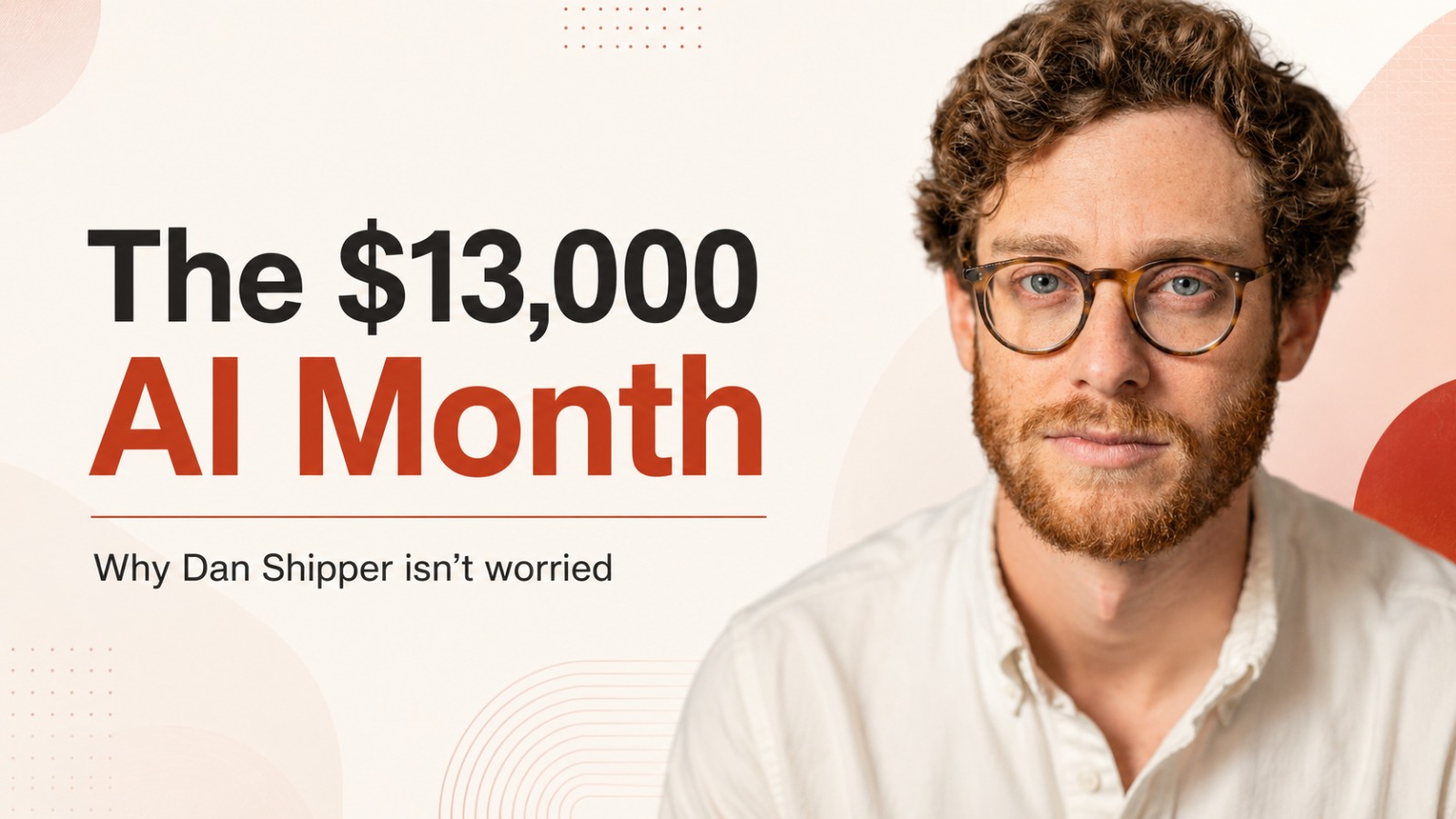
For most companies, a $13,000 software overage would trigger a round of uncomfortable budget questions. For Dan Shipper, co-founder and CEO of the AI-focused startup Every, it appears to have become something closer to the price of modern work.
Shipper recently revealed that he spent about $13,000 on OpenAI’s Codex in a single month. The bill, he said, came from his own personal Codex overages and stood out as one of the highest AI-related expenses he could remember. Compared with what the company was spending a year ago, he described the jump as “way, way, way, way, way, way, way, more.”
Yet the striking part of the story is not just the number. It is Shipper’s reaction to it.
At Every, AI is no longer being treated as a shiny experiment or a side tool for tech enthusiasts. It is being folded into the basic structure of work. Shipper has compared access to AI with standard workplace costs such as laptops and employee benefits, a sign of how quickly generative AI tools are moving from optional productivity boosters to daily infrastructure.
Every, a New York-based company operating across media, software and AI consulting, provides AI subscriptions to all of its 27 employees. Entry-level subscriptions are covered for the broader team, while technical employees receive access to higher-tier plans. The company also pays for token overages and does not enforce strict usage limits, as long as the spending remains financially sustainable.
Codex as a Daily Work Companion
Shipper’s own use case shows why the bill climbed so sharply. He uses Codex not merely for coding support, but for routine executive work. The system helps him read emails, manage his calendar, suggest meeting times and draft responses. It does not send messages on its own, but Shipper said much of the correspondence around his interview with Business Insider was generated by AI. “All the words are pretty much Codex,” he told the publication.
That detail matters because it shows where AI adoption is heading inside some workplaces. The technology is not limited to developers writing code or analysts summarising documents. It is entering the everyday administrative layer of work, the inbox, the meeting schedule, the first draft, the follow-up note, the sales proposal and the task tracker.
For companies like Every, the question is no longer whether employees should use AI. It is how deeply AI should be allowed to sit inside the workflow.
From Personal Agents to Team Agents
Every’s approach has also evolved. The company initially experimented with giving individual AI agents to employees. Later, it moved towards a model where specialised agents support entire teams.
One such agent, named Claudie, works with the consulting division. Its responsibilities include creating presentation drafts, preparing sales proposals and tracking client tasks.
That shift is important. A personal AI assistant may help one employee move faster. A team-level agent can reshape how a department works. It can standardise repetitive tasks, reduce waiting time between steps and keep work moving across multiple people.
This is where the cost debate becomes more complicated. A $13,000 monthly bill sounds high when seen as a software expense. But companies adopting AI deeply may view it differently: as labour support, speed, workflow compression and an alternative to adding headcount for certain kinds of repetitive work.
Jobs May Change Before They Disappear
Shipper has argued that AI is more likely to reshape jobs than replace them outright. His view is that the technology could push more workers into managerial and supervisory roles, especially if people increasingly manage AI systems rather than perform every task manually.
That is an optimistic view, but not a careless one. Shipper has also acknowledged that AI still struggles with something deeply human: knowing what is genuinely interesting or valuable. He pointed to creative fields such as writing, where judgment still matters.
This is perhaps the most grounded part of the story. AI can generate, organise, summarise and suggest. But deciding what deserves attention, what sounds fresh, what carries emotional weight and what will actually matter to a reader or client remains a human responsibility.
Why Codex Matters in the Bigger AI Race
Shipper’s comments come at a time when AI coding and productivity tools are gaining traction across the technology industry. OpenAI President Greg Brockman has said that AI coding tools have advanced rapidly and can now generate as much as 80% of a developer’s code, while still requiring human oversight.
That last phrase is the balance point. Human oversight remains essential. Even in companies that are willing to spend aggressively on AI, the technology is not being described as fully autonomous replacement labour. It is being used as a force multiplier, one that can draft, build, organise and accelerate, but still needs direction.
Shipper has also expressed confidence in Codex despite competition from companies such as Anthropic. And in a lighter moment, while discussing prompt-writing habits, he said he remains polite to AI systems because “you never know when they’re going to take over the world.”
The joke works because it sits on top of a very real workplace shift. AI is becoming normalised not only as a tool employees use, but as something companies budget for, structure teams around and absorb into operating costs.
The $13,000 Codex bill is not just a story about one CEO’s spending. It is a glimpse into how AI-native companies are beginning to think about work itself.
At Every, AI access is being treated less like a perk and more like infrastructure. Employees receive subscriptions. Technical staff get stronger access. Token overages are covered. Team agents handle recurring work. The CEO uses Codex for emails, scheduling and drafting.
That model will not fit every company immediately. Many businesses will still worry about cost, accuracy, security and control. But Shipper’s case shows one direction the market may move in: AI as a default workplace layer, not a separate innovation project.
The real question for companies may soon shift from “Can we afford AI tools?” to “Can we afford teams that do not know how to work with them?”
Also Read: Who Owns Your Team Now? IPL’s Latest Ownership Breakdown
















