

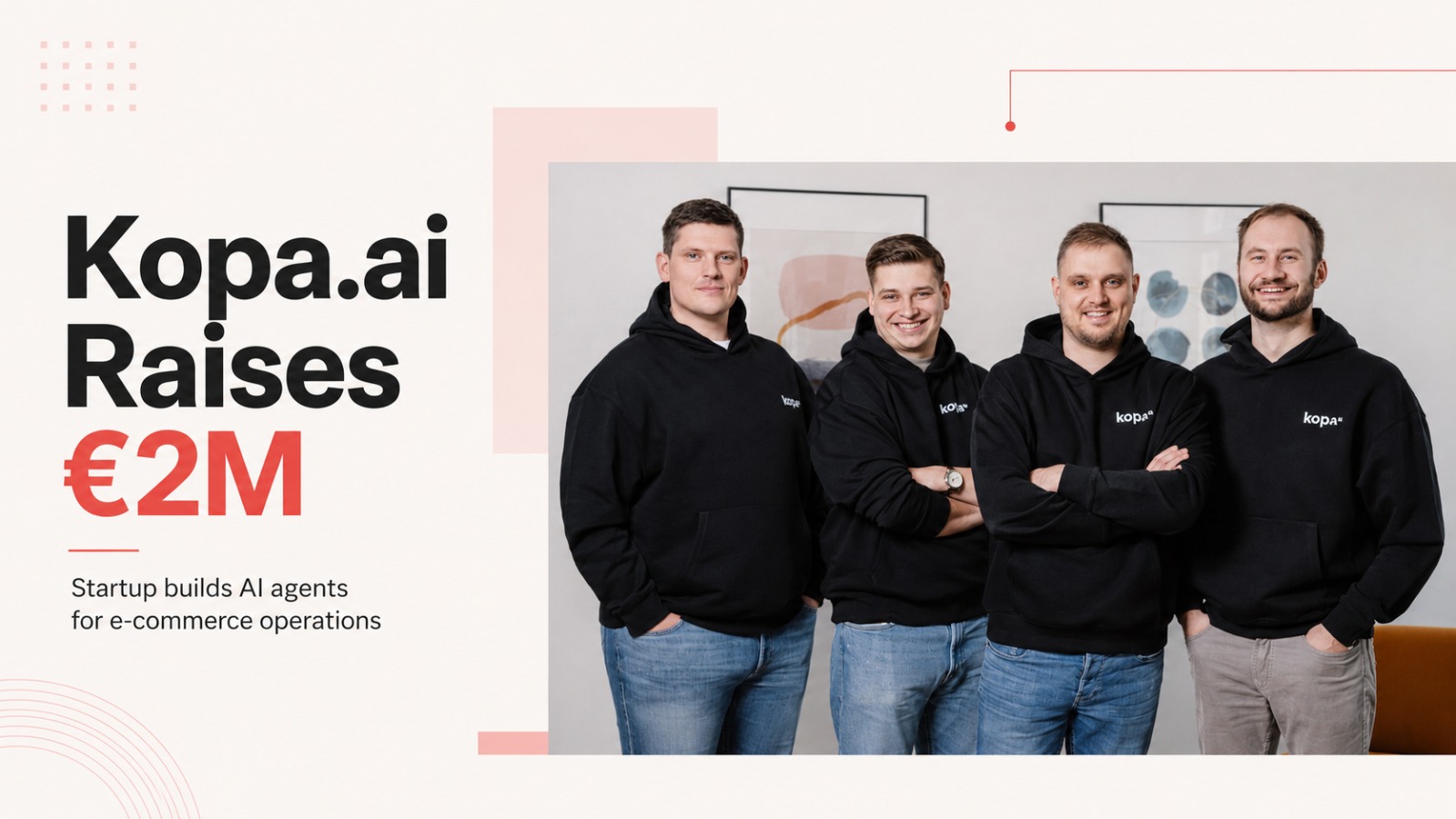
Vilnius-based Kopa AI has raised €2 million in seed funding to build what it describes as an AI operating system for e-commerce brands, with agents that can handle marketing, creative production, budgeting, store operations and performance decisions across a merchant’s business.
The round was co-led by XTX Ventures, the venture arm of algorithmic trading firm XTX Markets, and Practica Capital, the Baltic venture capital firm based in Vilnius. London-based entrepreneur and Remagine Ventures partner Etan Ilfeld also joined the round as an angel investor.
For Kopa.ai, the timing is important. E-commerce teams are no longer struggling only with customer acquisition or rising competition. A bigger daily challenge is the sheer number of moving parts inside a modern online business: campaigns, creatives, stock, pricing, customer behaviour, storefront updates, analytics, and multiple tools that rarely talk to each other smoothly. Kopa.ai is trying to solve that problem by giving online merchants AI agents that do not just surface insights, but act on them.
Kopa AI: Built by operators, not just software founders
Kopa.ai was founded in 2023 by Donatas Benaitis and Vytautas Krutulis, along with a team that had spent more than a decade building direct-to-consumer brands. That operator background is central to the company’s pitch.
The founding team has launched more than 100 e-commerce brands that together generated between $300 million and $400 million in annual revenue. That experience appears to have shaped Kopa.ai’s product direction. Instead of building a narrow dashboard or a single automation layer, the company is positioning its platform as a broader operational system for online brands.
Kopa.ai connects directly with a merchant’s store and operating tools. Once connected, its AI agents analyse products, campaigns, budgets, customers, inventory and site performance. The platform is designed to interpret business intent, make decisions and execute tasks such as launching campaigns, reallocating budgets, generating creatives and updating storefronts.
That distinction matters. Many e-commerce software products help teams see what is happening. Kopa.ai wants to move closer to doing the work itself.
“Most e-commerce businesses could grow far faster if operational complexity wasn’t holding them back. We’re building Kopa.ai to feel like handing work to your best expert, someone who understands what you want, makes smart decisions, and delivers results,” Benaitis said.
From public launch to €1M ARR in six months
Kopa.ai became publicly available in December 2025. Within roughly six months, the company reached €1 million in annual recurring revenue. The platform now serves more than 2,000 customers across Europe.
The wider business group has crossed $2 million in total annual recurring revenue. While early growth numbers alone do not guarantee long-term durability, they do indicate that Kopa.ai has found demand among e-commerce businesses looking for more than point solutions.
The fresh seed capital will be used to strengthen the company’s AI infrastructure, expand its engineering team and accelerate go-to-market activity across Europe.
Why e-commerce teams are looking beyond dashboards
The e-commerce software market has become crowded with tools that solve individual problems. One product may handle attribution, another may help with email marketing, another may generate copy, while another may track inventory or creative performance. For small and mid-sized brands, this creates a second layer of work: managing the tools meant to reduce work.
Kopa.ai is entering this gap with a more integrated promise. Its agents are built to understand how different functions inside an e-commerce business affect one another. A marketing decision, for example, may influence stock movement, creative demand, budget allocation and storefront performance at the same time. The company’s bet is that AI systems should not be locked inside one department or one narrow workflow.
This is where Kopa.ai’s “360-degree” approach becomes central. The platform is designed to operate across the full e-commerce lifecycle instead of focusing only on analytics, content generation or ad optimisation.
A crowded but fast-moving AI commerce race
Kopa.ai is not entering an empty market. The broader AI commerce infrastructure space is moving quickly as platforms shift from analytics and automation to agentic execution.
Shopify continues to embed AI into merchant workflows. Triple Whale and Northbeam have focused on predictive multi-channel data and marketing attribution. Jasper, Klaviyo and social ad generators such as Holo operate closer to the creative, customer engagement and campaign layer.
Recent activity in the sector shows how much investor attention is flowing into AI-powered commerce systems. ZyG raised $60 million from Accel to scale an agentic e-commerce operating system. Chord raised $7 million to build an AI context layer for mid-market brands. Brooklyn-based Mega raised $11.5 million for an AI agent network designed to replace traditional growth marketing agencies for small and medium-sized businesses.
Against that backdrop, Kopa.ai’s challenge will be execution. The company is not simply promising better content generation or sharper attribution. It is asking brands to trust AI agents with operational decisions across the business. That is a bigger product opportunity, but also a harder trust problem to solve.
Kopa.ai plans to keep deepening its AI infrastructure so its agents can take on more complex operational and strategic decisions. The company’s long-term view is that AI agents could allow very small teams, and possibly solo founders, to run e-commerce businesses without the traditional operational overhead.
That vision fits a broader shift in software. The next phase of AI tools is moving away from “assistant” products that wait for instructions and toward systems that can interpret goals, make decisions and complete tasks across multiple business functions.
For e-commerce brands, the appeal is obvious. The question is whether AI agents can become reliable enough to handle the messy, fast-moving reality of online retail. Kopa.ai’s early traction suggests that many merchants are already willing to test that idea.
Also Read: Vaibhav Suryavanshi’s Rise Is Bigger Than a Net-Worth Number

















