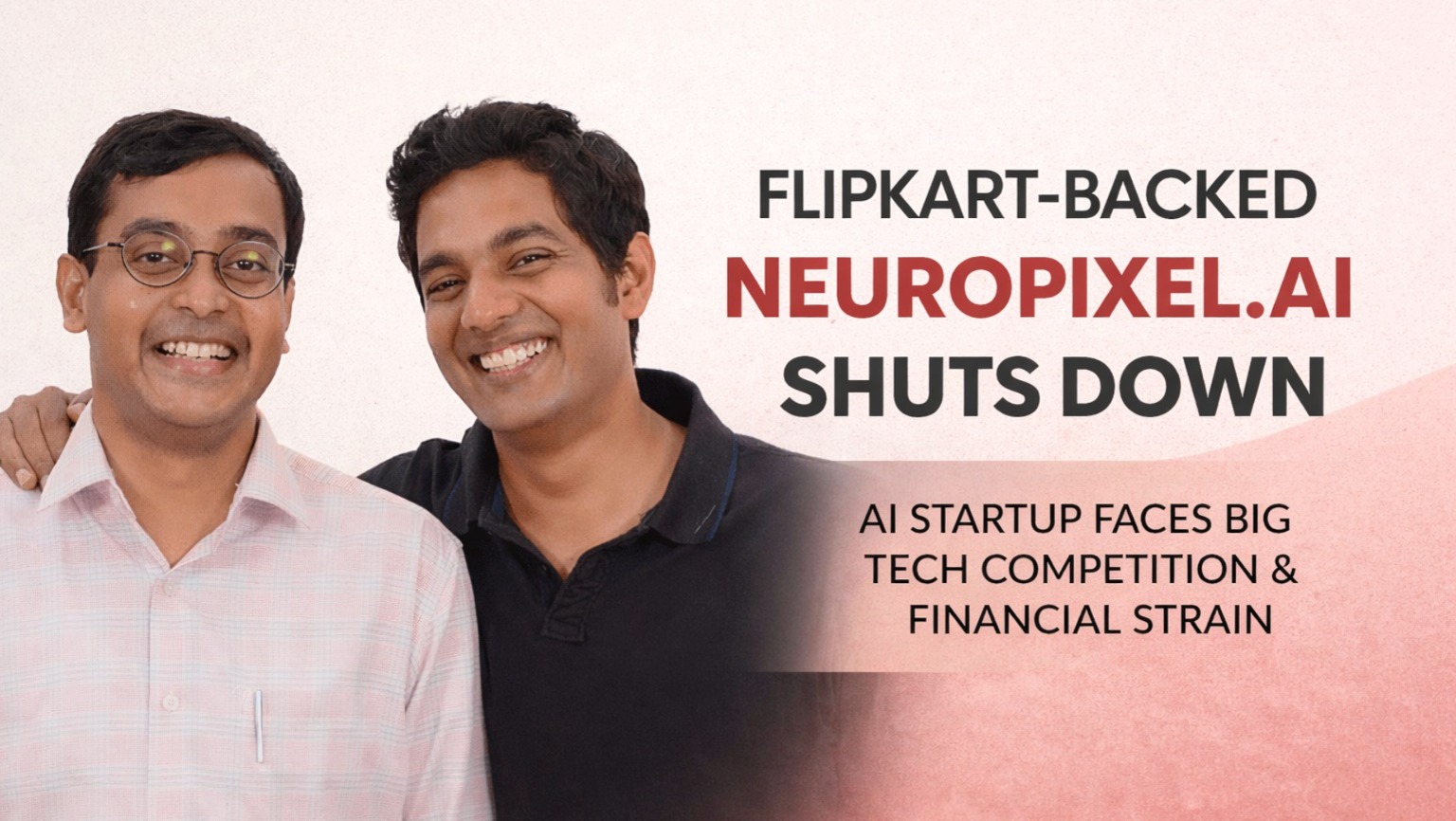
Bengaluru-based NeuroPixel AI, a startup that built generative AI tools for the fashion ecommerce market, has shut down its operations after around six years, in a development that highlights the growing pressure on India’s AI application-layer startups.
The shutdown was confirmed by cofounder and CEO Arvind Venugopal Nair, who said the company was hit by a combination of weak business penetration, rising competition from large technology players, and financial stress after losing a major client whose payments remained overdue for more than six months.
NeuroPixel.AI operated in a space that, until recently, looked full of promise. The company developed AI-led tools for fashion cataloguing, synthetic model generation, and virtual try-ons, aiming to help ecommerce brands cut production costs and improve the quality of product presentation online. Founded in 2020 by Nair and Amritendu Mukherjee, the startup positioned itself as a practical technology partner for brands trying to scale visual content faster and more efficiently.
Its client list reflected that ambition. NeuroPixel.AI worked with names such as Myntra, Fabindia, Van Heusen and Decathlon, offering a pay-per-image model that sought to reduce catalogue and marketing costs for brands handling large product volumes. The startup also said its tools could cut image production expenses by up to 70%.
Yet the business ran into a problem that is becoming increasingly common in the AI sector: strong technology was not enough to guarantee survival.
Nair said the company’s proprietary stack remained competitive on output quality and was available at a much lower cost than some global offerings, but it struggled when it came to scale and distribution. He specifically pointed to the intensifying competition created by large players entering the image-generation market, including Google’s NanoBanana Pro.
NeuroPixel AI shutdown signals market shift
That comment captures the larger challenge facing many young AI companies today. Startups may still be able to build useful products and even match the quality of bigger platforms in narrow use cases, but converting that into sustainable market share is becoming much harder. Distribution, compute access, capital strength and customer trust now matter just as much as product performance.
For NeuroPixel.AI, the commercial strain appears to have become impossible to absorb. The loss of a major customer, combined with unpaid dues stretching beyond six months, added financial pressure to an already difficult competitive environment. The company has said it is exploring ways to monetise its technology stack, but its service operations are effectively being shut.
The startup had raised around $1.2 million from investors including Flipkart Ventures, Inflection Point Ventures, Entrepreneur First, Huddle and Dexter Ventures. It had also built proprietary technology in computer vision and image processing, with patents in areas such as synthetic human generation and apparel rendering.
Its shutdown is not an isolated event. It comes at a time when several AI and startup ventures in India are being forced to confront tougher questions around differentiation, profitability and long-term defensibility.
Another fashion-focused AI startup, Alle, shut down earlier in 2026 after struggling with product-market fit and a sustainable business model. In 2025, names such as subtl.ai, CodeParrot and Astra also shut down amid funding pressures, weak differentiation and scale challenges.
Investor caution has also grown sharper. An Inc42 survey of more than 100 Indian startup investors found that 44% viewed lack of moat as the biggest risk in AI startups, while 20% flagged unclear unit economics. The message from that data is blunt: investors are no longer impressed by AI branding alone.
They want evidence that a startup can build a defendable business, not just a clever layer on top of someone else’s infrastructure.
That is what makes NeuroPixel.AI’s closure significant. This was not a startup without customers, without product focus, or without backers. It had recognisable clients, venture support and a clear sectoral use case. Even then, it could not withstand the speed at which the market changed around it.
In many ways, this is less the story of one company shutting down and more the story of a sector maturing brutally fast. As foundational AI models improve and become more widely accessible, smaller startups built around narrow, applied use cases are being forced into a far more unforgiving battle for relevance. Some may survive by owning distribution, enterprise relationships or proprietary workflows. Others may discover, too late, that product quality alone is no longer enough.
NeuroPixel.AI’s end may therefore be remembered not simply as a startup shutdown, but as another sign that India’s AI ecosystem is entering a tougher phase, where survival will depend on far more than innovation.
Also Read: Pronto – Instant Home Cleaning Services in Just 10 Minutes!