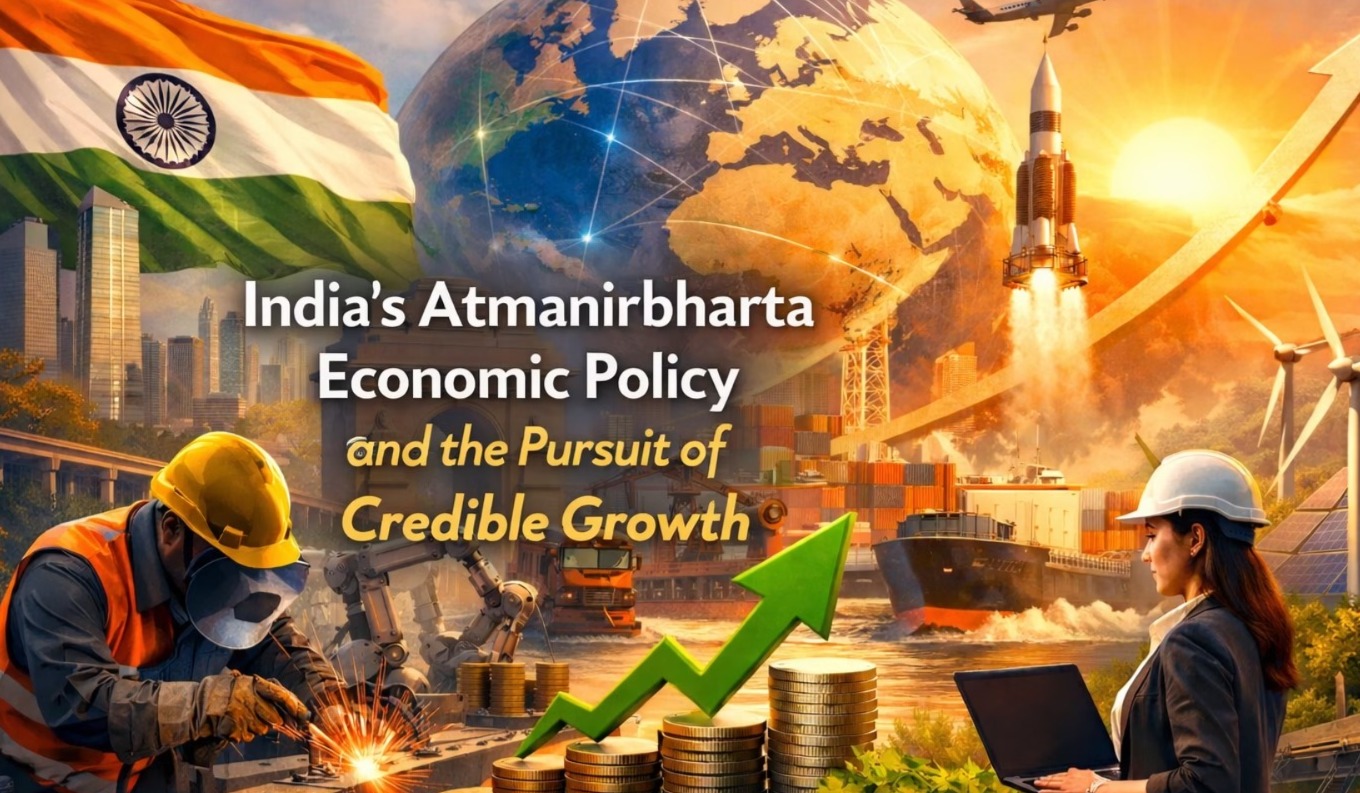
Coming up with the India Atmanirbhara economic policy has become one of the key pillars of the economic strategy of the country in a period when the world is changing to a structural one. Fragmentation in trade, geopolitical conflicts, and the decline in multilateral institutions are defining the ways nations are seeking development.
It is against this backdrop that India has placed emphasis on self-reliance and strategic openness as indicators of recalibration as opposed to a reduction in global interaction. This verdict is supported by the recent comments of Shaktikanta Das, Principal Secretary to the Prime Minister. His point that India now has the wind in its sails can be discussed as confident, which is based on continuity in policy, institutional reform, and macroeconomic stability instead of cyclical profits in the short term.
The Redefining of Self-Reliance.
The philosophy of Atmanirbhara as an economic policy of India has a subtle understanding of the term “self-reliance” at its core. The modern structure is built to develop the national capability, as opposed to the isolation component that defined previous models, and is in line with global value chains. The goal is resilience, making sure that the external shocks do not undermine the long-run growth.
The disturbances of the COVID-19 pandemic and then the collapse of supply chains and restrictions in the geopolitical situation revealed the danger of overreliance on outsourcing essential products and technologies. In reaction, India has focused on internal production, energy sufficiency, and technological readiness, which is one of the priorities of policy that has been promoted on the basis of the recent world crisis.
Autonomy of policies and Indian strategic positioning.
The India Atmanirbhara economic policy too intersects near the foreign policy. When there is a robust domestic economic foundation, strategic autonomy is increased, and India can flexibly sail through global trade negotiations, energy, and geopolitical relations. In the world where commerce and technology are more frequently employed as means of power, economic power has become unavoidably linked to diplomatic plausibility.
This balanced strategy is demonstrated in the way India continues to pursue the path of a rules-based global system and, at the same time, develop bilateral and regional ties. Instead of giving up multilateralism, India is adjusting to the world in which cooperation is more selective and power more diffused.
Expansion, Reputation, and Financial Stasis.
At the domestic level, the India Atmanirbhara economic policy has been accompanied by the long-term investment in infrastructure by the population, the changes in the ease of doing business, and constant growth in the services sector. All these policies have contributed to growth despite the weakened external demand.
What is more important, they add economic credibility. Consistency is gaining more and more importance with investors as opposed to growth spurts. The focus on predictability in policy-making frameworks and institutional soundness in India has contributed to making it a sort of stable place in the global uncertainty.
It is noteworthy that this transformation of the economy went from being viewed as simply incredible to being regarded as credible. Discipline, continuity of reform, and capacity to take shocks without sudden policy changes are elements of building credibility, and these elements are the qualities that the current policy direction tries to strengthen.
The Future Problems of India’s Atmanirbhara Economic Policy.
The India Atmanirbhara economic policy has a demanding external environment except in its strengths. Protectionism is on the increase, global supply chains are being broken up by reshoring and friend-shoring, and entry to technology and access to capital could be difficult. The implementation will determine success, will the capacity-building at the domestic level be translated to productivity, innovation, and inclusive growth?
The future will require long-term reforms, fiscal responsibility, and institutional coordination. Fresh impetus will not be enough.
Short-Term Tactical Change, Strategic Continuity Intact
Finally, the India Atmanirbhara economic policy is a strategic realignment but not a strategic response. It recognizes the facts of a divided global economy even as it puts India in the place where it can be able to interact with the world from a position of strength. The winds might be in favor of India, but it would need a stable regime and long-term perspective on the seas of fluctuating world matters.
Also Read: Karan Adani Announces ₹1.5 Lakh Crore Investment in Kutch at Vibrant Gujarat 2026