

Bengaluru’s deep-tech story is no longer limited to software parks, pitch decks, or polished startup events. A quieter, harder revolution is taking shape on factory floors, in industrial pockets, and inside workshops where young founders are building machines that could change logistics, surveillance, defence, and mobility.
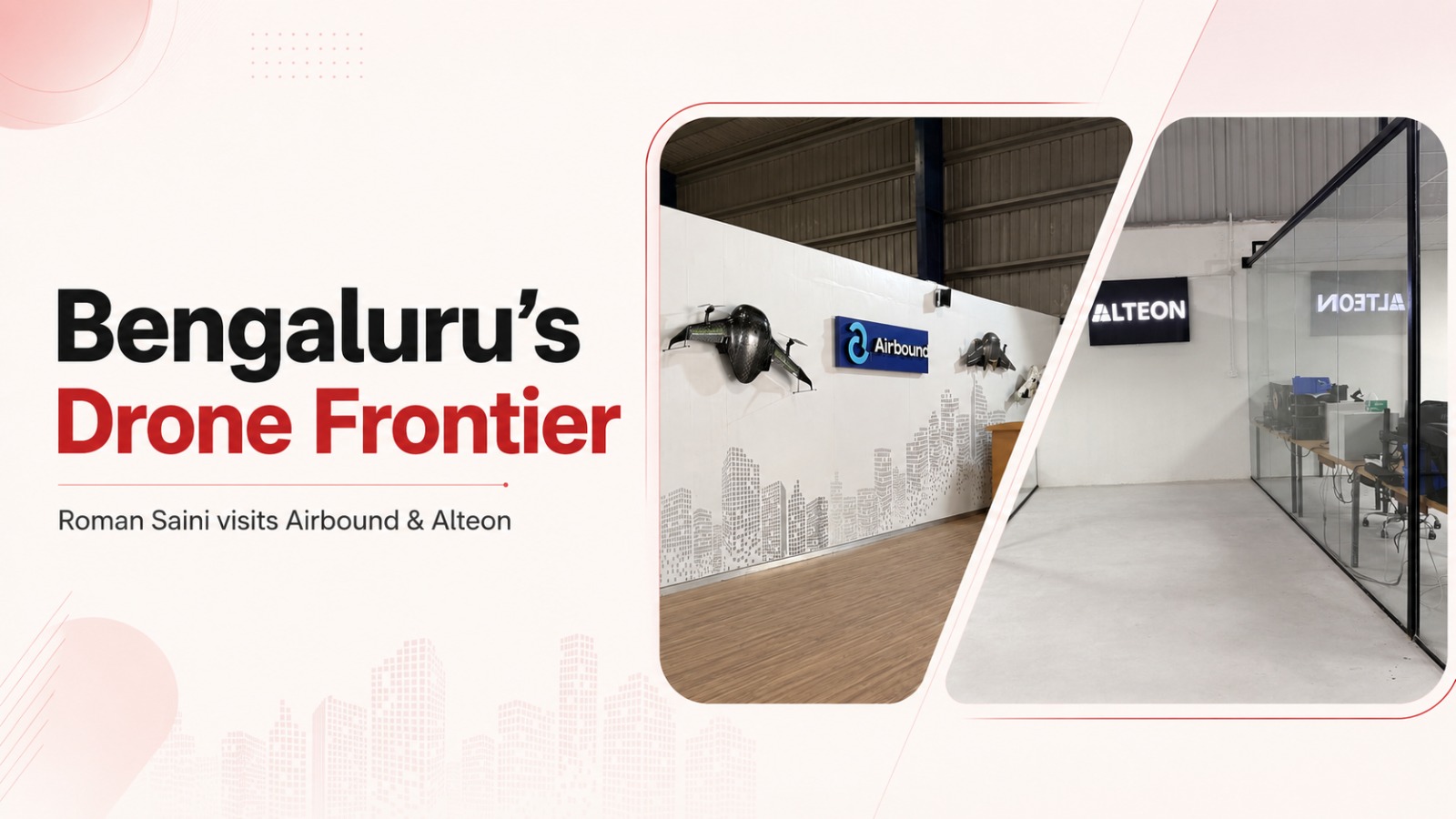
Over the weekend, Roman Saini, co-founder of Unacademy, visited two drone startups based out of Hoskote in Bengaluru: Airbound and Alteon Energy. His visit offered a rare ground-level look at India’s emerging hard-tech ecosystem, where drones are not just being designed on screens but manufactured, tested, lifted, and flown in real environments.
There was also an interesting common thread. Both startups are led by founders from Mumbai, yet both had to relocate to Bengaluru because operating from Mumbai was not feasible for them. For Saini, this reflected a larger point about Bengaluru’s startup culture. The city does not merely provide office space. It offers an ecosystem that is wired to improve a founder’s odds of success, across sectors and domains.
Airbound: A 21-Year-Old Founder Building Lightweight Delivery Drones
At Airbound, Saini met Naman, a 21-year-old founder deeply focused on drones and logistics. The startup is building extremely lightweight drones designed to deliver a 1 kg package across a few kilometres.
The use case is already practical. According to Saini, Airbound is flying blood samples for Narayana and other hospitals. That gives the company a real-world logistics problem to solve, rather than a distant futuristic idea.
What stood out most was the founder’s focus on unit economics from the beginning. Naman told Saini that Airbound’s drones cost around $2,500, which he said is 10 to 20 times cheaper than Zipline’s drones. For a young founder working in a capital-intensive sector, that cost discipline is significant.
Saini described the experience of watching the drones being manufactured in front of him and holding them in his hand as “amazing.” The real surprise, he noted, was how lightweight they felt. It is the kind of detail that is hard to understand from a video or photograph. The weight becomes real only when the drone is physically in one’s hand.
For now, Airbound’s focus is on carrying payloads of around 1 kg, enough for a bunch of blood samples meant for lab testing. The larger ambition, however, goes far beyond medical logistics. The company eventually wants to move heavier payloads, and in the long run, Saini wrote, the “ultimate vision” could extend to human transportation.
That may sound futuristic today, but Bengaluru’s traffic problem makes the idea feel less like fantasy and more like a challenge waiting for a serious engineering solution.
Alteon Energy: Building Drones That Can Stay in the Air for 400 Days
The second startup Saini visited was Alteon Energy, founded by Samay. The office itself made an impression. It was designed as a single-floor workspace with glass walls, allowing the entire team to see different parts of the company’s operations, including drone manufacturing, from almost anywhere inside.
Alteon Energy is working on what Saini described as the world’s highest endurance drones. The claim is ambitious: drones that can remain in the air for more than 400 days without landing even once.
Their core use case is maritime surveillance. The idea is to deploy thousands of 9-foot-wingspan drones over the sea, where they can continuously observe coastal and maritime zones. Saini wrote that he lifted one of these drones himself, and despite its wingspan, it weighed only a few kilograms.
The startup’s cost vision is equally striking. Just as low-cost CCTV cameras changed on-land surveillance by making constant monitoring affordable, Alteon wants to bring down the cost of flying to under $1 per hour.
The comparison used by Saini is sharp. At that cost, the startup believes more than 10,000 such drones could operate at the cost of running one Arleigh Burke-class destroyer. The larger dream is to have millions of drones flying perpetually, assisting the coast guard and navy with surveillance.
If such systems work at scale, they could help in detecting and preventing piracy, drug trafficking, human trafficking, arms trafficking, illegal fishing, and other maritime threats. In Saini’s framing, the aim is to make the coastline as effectively watched as land borders are today.
The Bengaluru Factor
The deeper story here is not only about two drone startups. It is also about why Bengaluru continues to attract founders building difficult products.
Hard manufacturing requires more than capital. It needs suppliers, engineers, early believers, testing culture, talent density, and a founder network that understands failure, iteration, and long development cycles. For drone startups, especially those working at the intersection of logistics, defence, surveillance, and advanced manufacturing, the surrounding ecosystem matters as much as the idea itself.
That is where Bengaluru appears to have an edge. Saini’s observation that both Mumbai-origin founders had to relocate to Bengaluru says something important about India’s startup geography. Mumbai may be India’s financial capital, but Bengaluru remains the country’s strongest operating base for many technology-led companies, especially those that need deep talent and a builder-first environment.
India’s Deep-Tech Moment Is Becoming Real
India’s startup story has often been associated with apps, platforms, consumer internet, fintech, edtech, and marketplaces. But the next phase may be much more physical.
Drones that carry blood samples. Ultra-light aircraft-like systems for maritime surveillance. Manufacturing floors where founders are testing cost, weight, endurance, and real-world deployment from day one. These are not easy businesses. They take time, patience, engineering discipline, and a willingness to build in sectors where failure is expensive.
But they also solve problems that matter.
India needs many more such deep-tech and hard-manufacturing startups. Some of the country’s most serious structural challenges, from healthcare logistics to border surveillance and urban mobility, may not be solved by imported systems alone. They will need indigenous solutions built for Indian constraints, Indian costs, and Indian realities.
Airbound and Alteon Energy show what that direction could look like. One is beginning with blood sample delivery. The other is thinking about persistent maritime surveillance. Both are trying to build something difficult from India, for India, with the possibility that the world may one day adopt these solutions too.
For now, the most important signal may be this: India’s deep-tech revolution is not just being talked about. In places like Hoskote, it is being built by hand.
Also Read: Ananya Birla and the New RCB Era: The Woman at the Centre of Cricket’s New Power Shift
















