

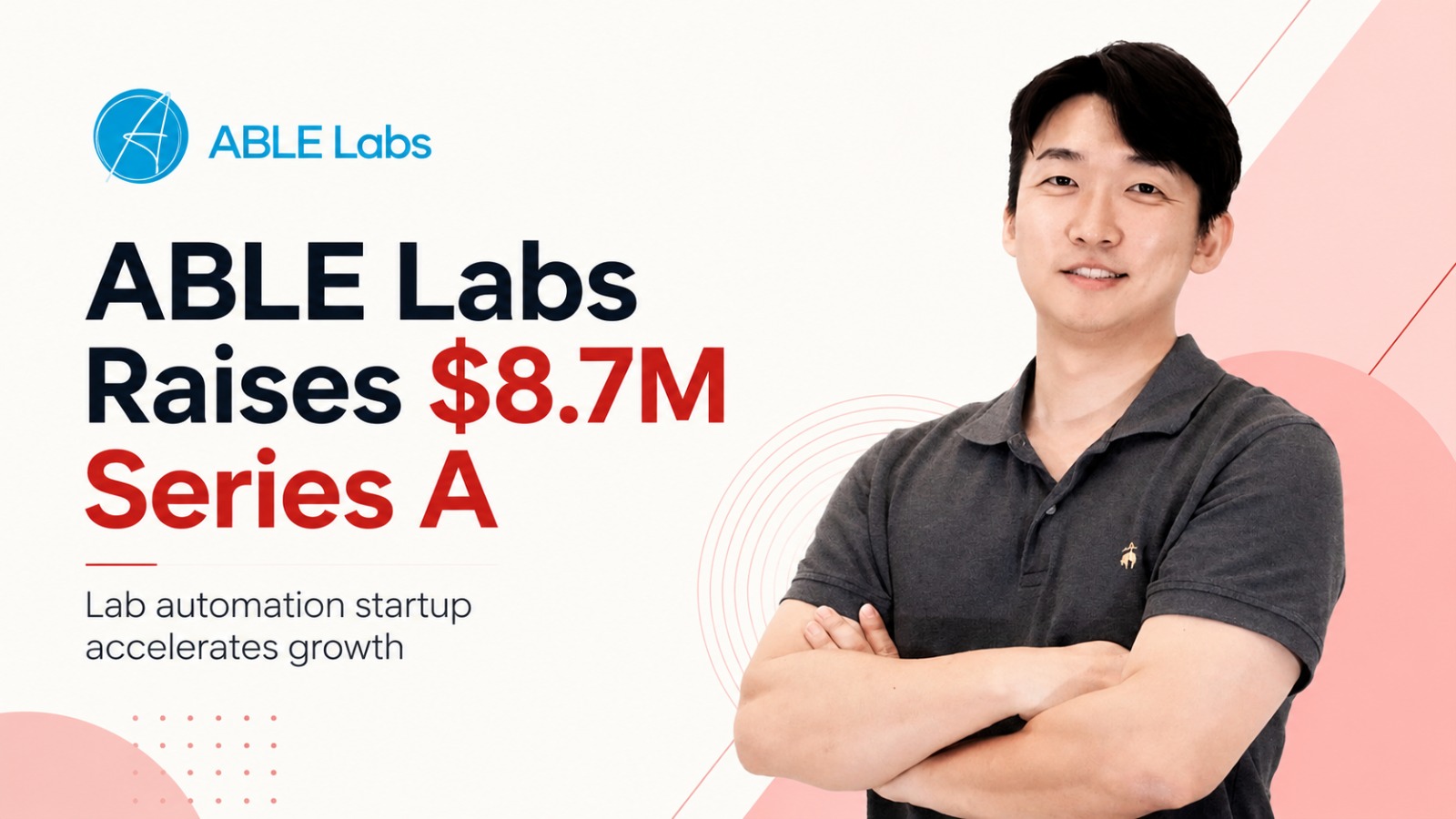
South Korean laboratory automation robotics startup ABLE Labs founed by Sang Shin has raised approximately $8.7 million, or KRW 12.1 billion, in a Series A funding round, giving the company fresh capital to broaden the scope of its automation technology and pursue opportunities beyond its biotechnology roots.
The round was led by Innopolis Partners, with participation from Industrial Bank of Korea, Capstone Partners, Horizon Investment, Magna Investment, Futureplay and NAU IB Capital.
ABLE Labs now plans to expand from liquid-handling robotics into self-driving laboratory systems, while also building infrastructure capable of generating experimental data for training AI models.
That direction comes as the startup is already pushing its automation technology into a wider set of industries. ABLE Labs has secured new quality-analysis automation projects in semiconductors, chemicals, cosmetics and secondary batteries, taking its business into four sectors outside biotechnology.
Revenue growth is being matched by a sharp rise in orders
One of the more notable figures behind the funding announcement is the pace at which ABLE Labs’ order pipeline has grown.
The company recorded KRW 1.29 billion in revenue in 2025, representing a 113 percent year-on-year increase. By the first half of 2026, its order intake had already exceeded twice the company’s entire revenue for 2025.
The comparison offers a clearer picture of the scale at which the business is trying to grow. Rather than remaining focused solely on laboratory robotics for life sciences, ABLE Labs is extending its automation systems into industrial quality analysis while developing technology aimed at increasingly autonomous laboratory environments.
Its next phase therefore combines two areas of expansion: a broader customer base across different industries and a deeper level of laboratory automation.
From liquid handling to self-driving laboratories
Liquid handling is one of the repetitive processes frequently automated inside laboratories, but ABLE Labs’ stated ambitions now extend further.
The company plans to develop self-driving laboratories, alongside infrastructure designed to generate experimental data that can be used in AI model training. This moves its focus beyond automating individual laboratory procedures toward systems capable of supporting a larger portion of the experimental process.
ABLE Labs has already deployed laboratory automation solutions at KAIST, Pusan National University and the Korea Research Institute of Chemical Technology.
Its research work also extends outside South Korea. The company is jointly developing an organoid-based drug evaluation platform with Johns Hopkins University in the United States.
ABLE Labs has carried out eight national research and development projects and secured more than KRW 10 billion in government research funding over five years.
International activity begins to take shape
The startup is also testing its technology with customers outside its domestic market.
ABLE Labs is currently carrying out a proof-of-concept project with a major US pharmaceutical company. The pharmaceutical company was not identified in the available information.
Separately, ABLE Labs has completed a product delivery to its first customer in Singapore, marking another step in its international commercial activity.
These developments sit alongside the company’s expansion into semiconductors, chemicals, cosmetics and secondary batteries, suggesting that its immediate growth plans are not tied to a single type of laboratory or customer.
With the Series A capital secured, ABLE Labs’ challenge will be to turn that widening project pipeline into a larger commercial business while advancing from task-specific laboratory robotics toward more autonomous research environments.
For now, the combination of KRW 12.1 billion in fresh funding, 113 percent revenue growth in 2025, and first-half 2026 orders already exceeding twice the previous year’s revenue gives the company a measurable base from which to pursue that expansion.
Also Read: Nexeon Raises €116.7 Million With UK Pilot Facility at the Heart of Its Silicon-Anode Scale-Up
















