

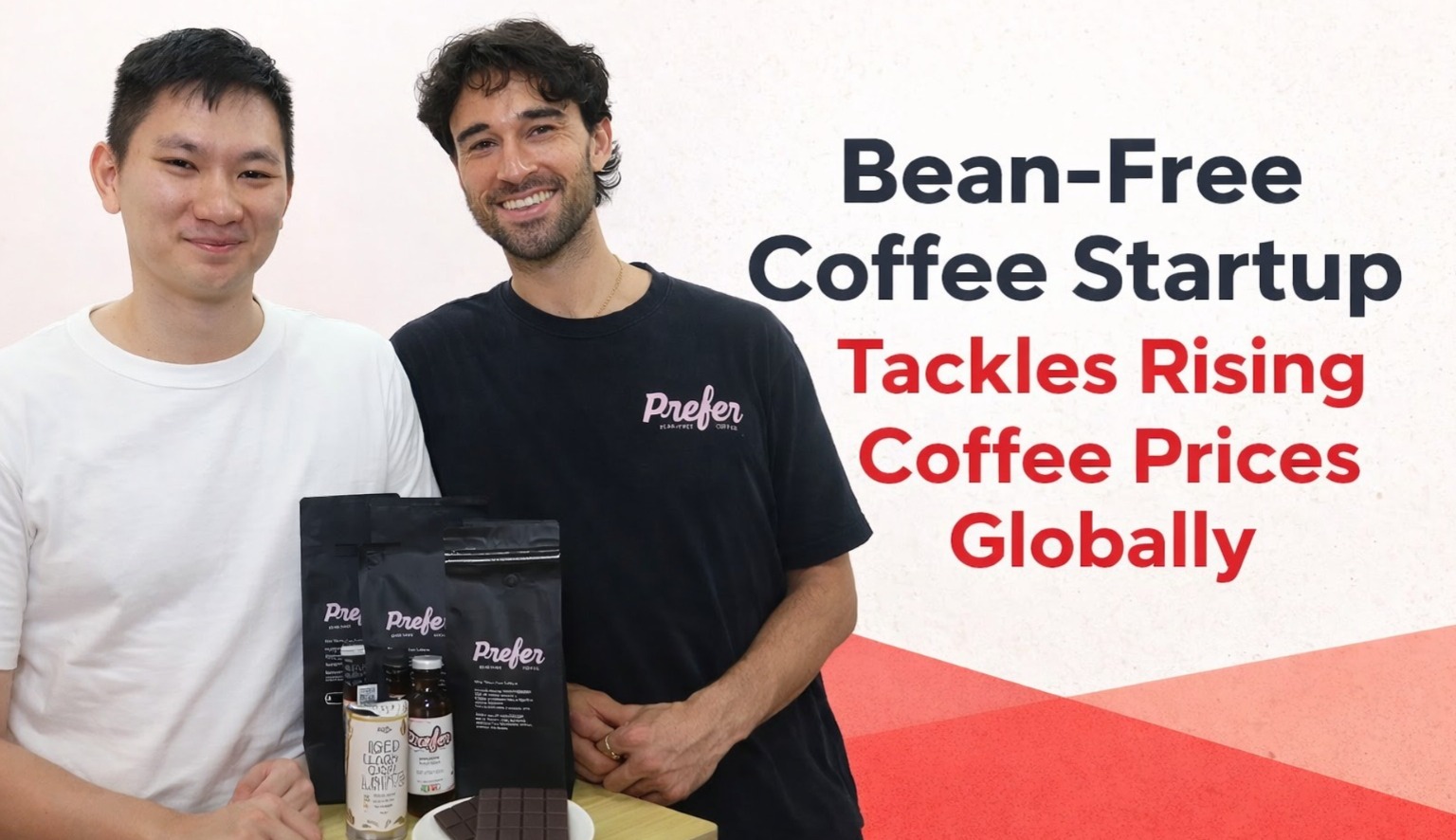
As global coffee prices surge to historic levels, a Singapore-based coffee startup is attempting to rewrite how the world consumes one of its most beloved beverages, without relying entirely on coffee beans.
According to data from the US Department of Agriculture’s Foreign Agricultural Service, average export prices for green bean robusta coffee in Vietnam touched US$5,642 per tonne in the 2024–2025 marketing year, marking a sharp 143% increase over the previous year. The spike has pushed Vietnam’s total coffee export value to US$8.3 billion, the highest on record.
Behind the surge lies a combination of climate disruptions and supply stress. In 2025, Typhoon Kalmaegi, along with extreme rainfall, hit key coffee-growing regions across Vietnam and the Philippines. Vietnam’s Central Highlands, a crucial production belt, saw significant crop damage, tightening global supply further.
It is against this backdrop that Singapore-based startup Prefer, founded by Ding Jie Tan and Jake Berber is building a business around what it calls “bean-free” coffee.
A response to volatility, not a replacement
Founded by avid coffee drinkers, Prefer’s founders say the idea was not to replace coffee, but to make it more resilient to shocks.
“We really want to show how we can work together with the industry… creating hybrid blends… to create products that everyone can afford and enjoy,” said co-founder Jake Berber.
The company uses fermentation technology to produce coffee and cocoa flavour compounds without relying fully on traditional crops. These ingredients can then be blended with conventional coffee, with up to 40% inclusion, while maintaining a similar taste profile at a lower cost.
“We decided to focus on building solutions to solve the problem of rising cost and volatility of coffee and cocoa supply chains,” Berber said, adding that fermentation allows flavours to be recreated in a fundamentally different way from agriculture.
Coffee Startup Prefer: From lab to shelves
Prefer is not limiting itself to ingredients. The company has also entered the consumer market with ready-to-drink canned coffee.
It first launched in early 2024 with a single iced oat latte. Since then, it has expanded under a rebranding to include iced black and iced white coffee, catering to both dairy-free consumers and those who prefer regular milk.
“We try to create the experience of coffee that everyone can continue to afford and love,” Berber said.
Its canned products are now available across more than 100 locations in Singapore, including vending machines and RedMart, priced between S$2 and S$3 depending on the outlet.
B2B model and local sourcing
At its core, Prefer operates as a business-to-business (B2B) supplier, providing bean-free coffee and cocoa powders to fast-moving consumer goods companies, private labels, and flavour houses both in Singapore and overseas.
The company also works with local manufacturing partners, sourcing food byproducts from brands such as Gardenia and Mr Bean as fermentation inputs.
Co-founder Tan acknowledged that entering a market deeply attached to traditional coffee has not been easy.
“Singaporeans… are deeply nationalistic and defensive about coffee and food,” he said, adding that the company faced “a healthy dose of scepticism” early on.
However, he noted that businesses have responded to the clear cost advantage without compromising on flavour.
Funding and global ambitions
Prefer’s expansion plans are backed by early investor confidence. According to Berber’s LinkedIn, the startup raised US$4.2 million in pre-Series A funding, taking total equity raised to US$6.2 million, including a US$2 million seed round in 2024.
The latest round was co-led by At One Ventures and Chancery Hill Capital, with participation from Analog Ventures.
The funds are being used to build and commercialise a pilot production facility, which Berber said will help the company prepare for a Series A round next year.
While Singapore remains its base, the company is increasingly looking outward. “Larger markets are abroad,” Berber said, noting that expansion efforts are now focused internationally.
Prefer has already entered partnerships beyond Singapore, including with Ajinomoto in Thailand, a major player in the ready-to-drink coffee segment and The Coffee Ferm in Australia.
It has also recently signed an agreement with a Japanese coffee company to develop a new blend using its fermentation-based product, PreferRoast. Further details are expected to be announced.
A shift brewing in coffee economics
As climate disruptions and price volatility reshape agricultural commodities, startups like Prefer are attempting to create buffers within the system rather than disrupt it entirely.
Their bet is simple: if coffee is becoming more expensive and unpredictable, the future may not lie in replacing it, but in blending tradition with technology to keep it accessible.
And in a world where a daily cup is both habit and comfort, affordability may be the biggest innovation of all.
Also Read: Native Raises $42 Million, Launches Multi-Cloud Security Platform















