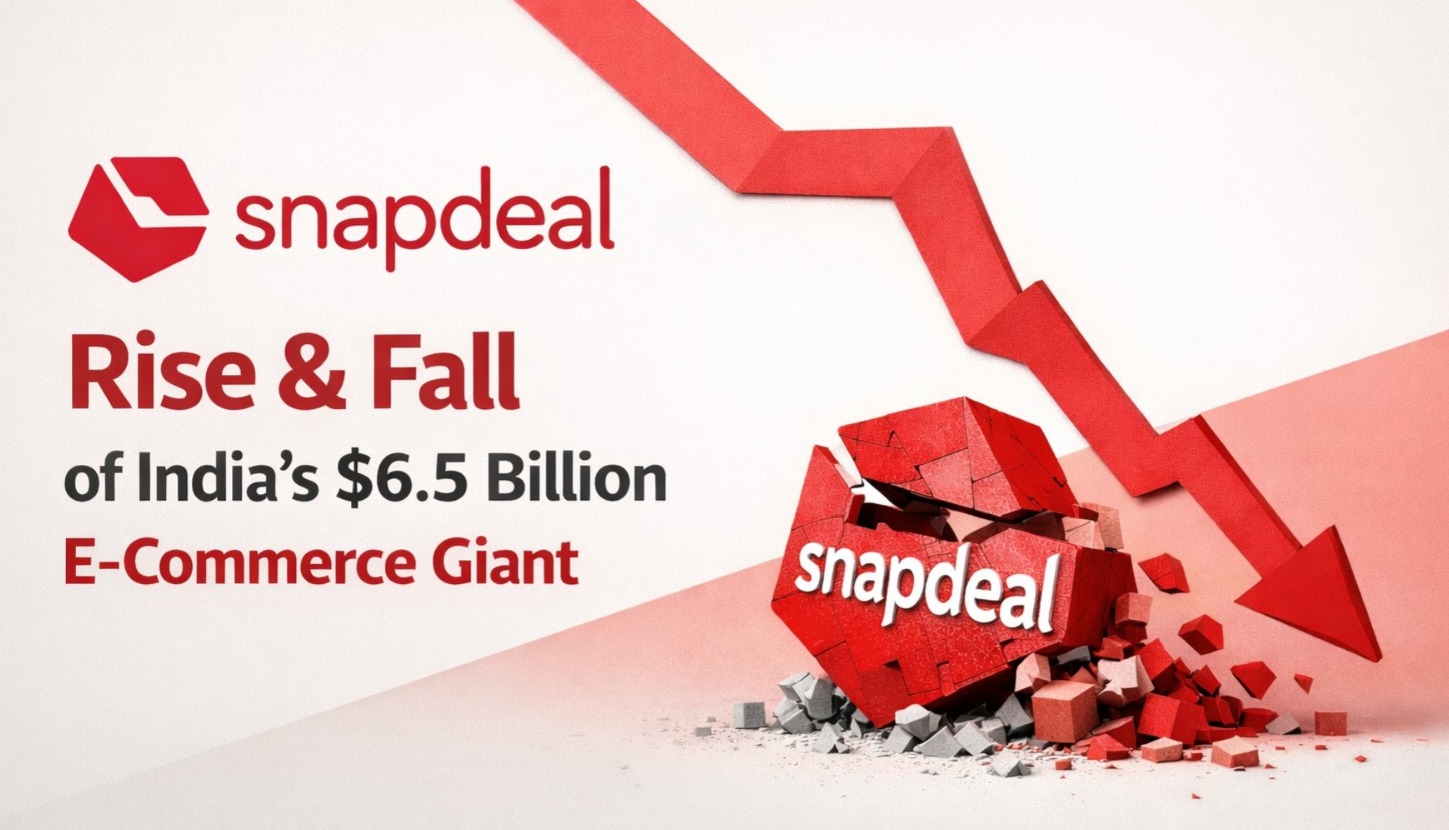
In India’s early e-commerce boom, Snapdeal was often seen as one of the country’s biggest digital commerce bets, a company that appeared ready to define how millions of Indians would shop online. At its peak, it was valued at $6.5 billion, backed by heavyweight investors including SoftBank Group Corp., Alibaba Group and Foxconn.
It had roughly 32% market share, more than 25 million users, and over 50,000 sellers on its platform.
For a while, the story almost wrote itself. Snapdeal was being spoken of as a future market leader, a company that seemed perfectly placed to ride India’s internet growth story.
But scale, as the company’s trajectory later showed, is not the same as durability.
As India’s e-commerce market matured, the competitive landscape changed sharply. Amazon committed billions of dollars to India, making it clear that this was not a tentative entry but a long-term battle. At the same time, Flipkart emerged as its main competitor, turning the market into a far more aggressive contest than Snapdeal had initially seemed prepared for.
The change was swift and unforgiving.
By early 2017, Snapdeal’s market share had fallen from around 32% to nearly 4%, a collapse that reflected more than just stronger rivals. It exposed how quickly leadership can erode in a market where customer habits, capital intensity and competitive pressure shift all at once.
To remain relevant, Snapdeal moved toward value commerce in Tier 2 and Tier 3 India. On paper, the pivot had logic. As Jio was bringing millions of new users online, the next big wave of digital consumption appeared likely to come from what is often called Bharat, smaller cities and towns where price sensitivity is high, internet adoption was rising, and the customer base was expanding rapidly.
The opportunity was real. But opportunity alone does not guarantee product-market fit. The strategy, as outlined in the post by Jeet Chandan, ran into three core problems.
The first was the 15-25% commission model in a highly price-sensitive market. In a segment where affordability often drives consumer decisions, such a structure can create friction rather than growth.
The second was seller expansion outpacing quality control. Growth in seller numbers may help build scale, but if platform quality and customer experience do not keep pace, the marketplace begins to weaken from within.
The third was a deeper strategic assumption: that larger rivals would stay away from the same value-conscious customer segment. That did not hold. In markets as large and contested as India’s, attractive segments rarely remain uncontested for long.
This is what makes Snapdeal’s story more than just another startup rise-and-fall narrative. It is not only about valuation peaking and then collapsing. It is about the distance between the story investors and markets like to tell, and the harder reality of whether a business model is truly aligned with the customer it wants to serve.
Capital can help a company scale faster. Valuation can amplify belief. Headlines can create the impression of inevitability.
But none of those things, on their own, can fix structural misalignment.
As the model doesn’t entirely align with the economics of the market, the quality of the platform deteriorates while it grows, and competition enters with deeper pockets and longer staying power, the momentum at some point begins to slow down. Not always dramatically, but sometimes quietly, until it can no longer be ignored.
That is perhaps the most striking lesson in Snapdeal’s decline.
Companies in fast-moving sectors do not always collapse in a single moment. Often, the loss happens in stages, a drop in relevance here, a missed strategic read there, a weakening grip on users and sellers, and then one day the market has already chosen someone else.
Snapdeal’s journey, viewed through that lens, stands as a powerful reminder for India’s startup ecosystem. Big funding rounds and market excitement can create the appearance of certainty. But in the end, customer fit, execution discipline and timing matter more than narrative.
And when those pieces stop aligning, even the most promising company can lose its place far faster than anyone expected.
Inputs from a LinkedIn post by Jeet Chandan.
Also Read: Have You Bought Noice Without Knowing It’s Swiggy’s?