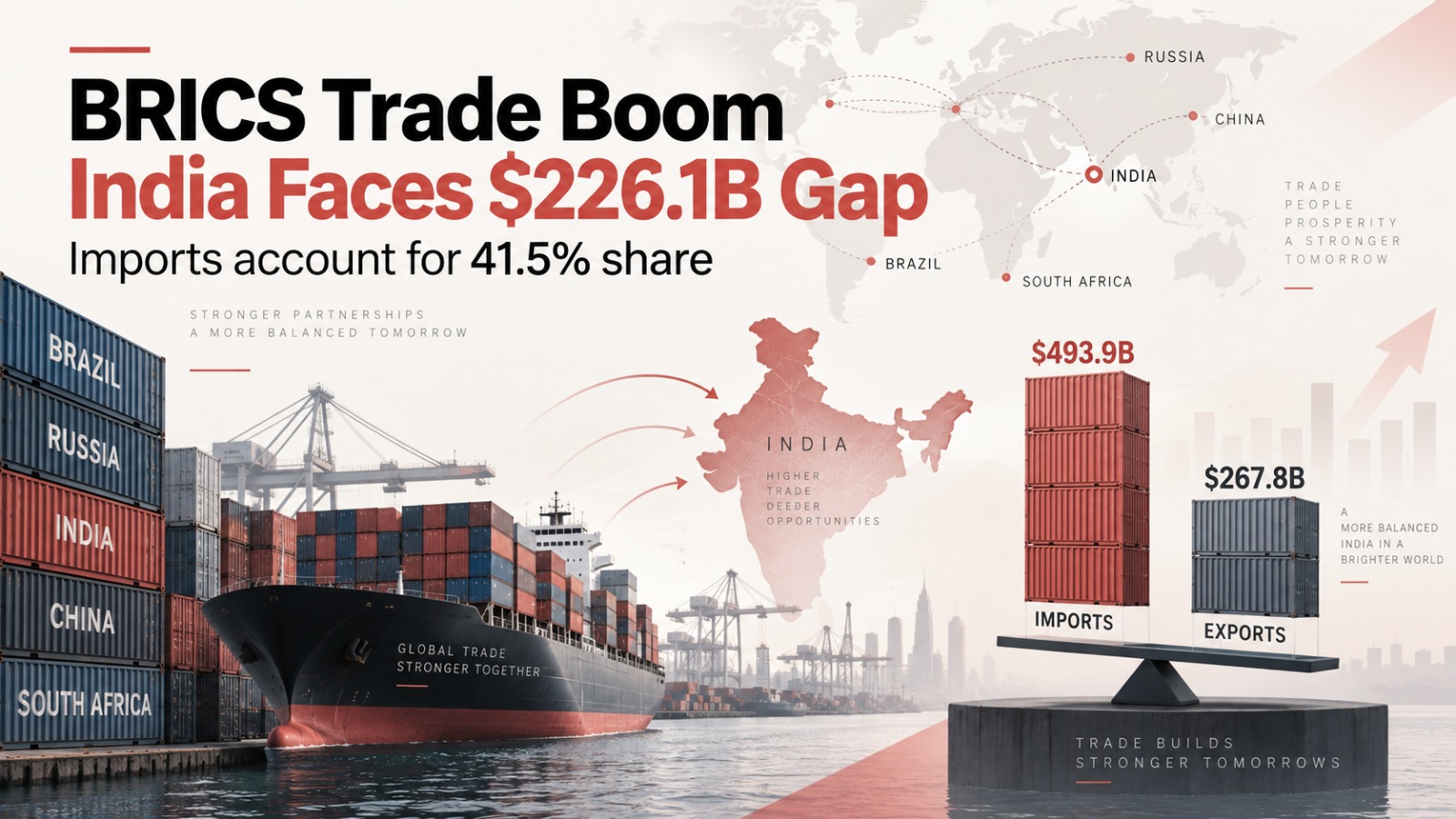
India’s trade with the BRICS grouping has more than doubled in five years, but the surge has come with a growing imbalance. The country’s merchandise trade deficit with BRICS widened to $226.1 billion in FY2026, more than three times the $74.5 billion deficit recorded in FY2021, according to the Global Trade Research Initiative (GTRI).
The numbers show that India’s trade relationship with BRICS is becoming increasingly import-heavy. BRICS countries accounted for 41.5% of India’s total merchandise imports in FY2026, compared with 35.2% in FY2021. Their share in India’s exports, however, slipped slightly from 22% to 21.7% over the same period.
India’s BRICS trade doubled, but imports grew much faster
India’s total goods trade with the 11-member BRICS grouping rose from $203.1 billion in FY2021 to $417.5 billion in FY2026.
However, the growth was far from evenly distributed.
Exports to BRICS increased 48.8%, rising from $64.3 billion to $95.7 billion. Imports, on the other hand, jumped 131.8%, from $138.8 billion to $321.8 billion.
That difference explains much of the widening deficit. BRICS has become significantly more important to India as a source of imported goods than as a destination for Indian exports.
The comparison with India’s trade outside BRICS makes the gap clearer. Exports to the rest of the world grew 52% between FY2021 and FY2026 to reach $345.8 billion, slightly ahead of the 48.8% growth in exports to BRICS.
The import trend was the reverse. Imports from countries outside BRICS rose 77.6% to $453.9 billion, while imports from BRICS surged 131.8%.
China, UAE and Russia account for most BRICS imports
A large part of India’s BRICS import bill is concentrated in China, the UAE and Russia. Together, the three countries accounted for almost 84% of India’s imports from BRICS in FY2026.
China alone accounted for about 41% of those imports.
India’s imports from China more than doubled from $65.2 billion in FY2021 to $131.6 billion in FY2026. At the same time, exports from India to China declined 8.1%, falling from $21.2 billion to $19.5 billion.
Russia recorded an even sharper increase in India’s imports. Purchases from Russia rose more than tenfold, from $5.5 billion in FY2021 to $55.4 billion in FY2026. The rise was mainly driven by higher energy purchases.
Indian exports to Russia also increased during the period, but by a much smaller amount, moving from about $2.7 billion to $4.5 billion.
The UAE remained an important market for Indian exporters within BRICS. India’s exports to the UAE rose 124% to $37.4 billion in FY2026, while imports from the country increased 140% to $63.9 billion.
UAE leads as India’s BRICS export destination
The UAE was India’s largest BRICS export market in FY2026, with shipments reaching $37.4 billion.
Saudi Arabia followed with exports worth $10.3 billion. Brazil and South Africa each accounted for around $7 billion, while Russia and Indonesia received about $4.5 billion each.
Not every market recorded growth. India’s exports to Indonesia, Iran and Ethiopia declined compared with FY2021.
The figures underline another feature of India’s BRICS trade. While some member countries have become important destinations for Indian products, the growth in exports has generally not matched the much faster expansion in imports.
BRICS has huge global trade power, but limited trade within the group
The imbalance is not limited to India. GTRI’s figures also point to a wider issue within BRICS itself.
The 11 BRICS economies, comprising Brazil, China, Egypt, Ethiopia, India, Indonesia, Iran, Russia, Saudi Arabia, South Africa and the UAE, exported $5.67 trillion worth of goods in 2025. That represented 21.6% of global merchandise exports.
Their combined imports stood at $4.58 trillion, equal to 17.3% of global imports. Together, the economies recorded a merchandise trade surplus of about $1.09 trillion.
Despite that enormous global trade footprint, trade among BRICS members remains comparatively limited.
BRICS members exported around $1.1 trillion worth of goods to one another, equal to 18.8% of their combined exports. Imports from fellow members stood at around $1.4 trillion, representing 29.5% of their total imports.
Measured against global trade, intra-BRICS exports accounted for only 4.1% of worldwide exports, while intra-BRICS imports represented 5.4% of global imports.
China remains at the centre of intra-BRICS trade
China occupies a central position in trade within the grouping.
Chinese exports to other BRICS members stood at $550.8 billion, while imports from fellow BRICS economies reached $464.9 billion.
India recorded the largest trade deficit within the grouping at $226.1 billion.
GTRI founder Ajay Srivastava described the pattern of intra-BRICS trade as a China-centred hub-and-spoke structure rather than a balanced trading network. The organisation identified better market access, lower trade barriers, improved logistics, local-currency settlements and more diversified supply chains as areas that could support greater trade among members.
For India, however, increasing intra-BRICS trade alone may not address the underlying problem. The key issue is whether Indian exports can grow fast enough to keep pace with imports.
India faces a larger trade challenge beyond BRICS
GTRI has suggested that India should pursue better market access in China, Russia and Indonesia, address non-tariff barriers and encourage higher-value exports. It also highlighted the need to reduce excessive dependence on a limited number of BRICS suppliers.
The concern is straightforward: if imports continue to grow considerably faster than exports, deeper trade with BRICS could increase India’s existing deficit rather than narrow it.
The BRICS imbalance also sits within a broader deterioration in India’s merchandise trade position.
India’s total goods exports increased from $291.8 billion in FY2021 to $441.5 billion in FY2026. During the same period, imports climbed from $394.4 billion to $775.7 billion.
As a result, India’s overall merchandise trade deficit widened from $102.6 billion in FY2021 to $334.3 billion in FY2026.
The GTRI India-BRICS figures are based on DGCIS data. Its estimates for intra-BRICS trade use the latest WITS data available for individual economies, with reference years ranging from 2020 to 2025 depending on the country.
Also Read: Hideo Kojima’s PHYSINT Moves to Xbox After Three-Month Partner Search Following PlayStation Exit