AI In Mental Health: By Sinchana P Heggade, Early Stage VC, Warmup Ventures
Mental health care in India is changing, but the system is still not built for the way people actually experience anxiety, stress, loneliness, burnout, or emotional distress today.
Therapy has become more acceptable, especially among urban Gen Z. The stigma has reduced. More young people are open to asking for help. But access, affordability, continuity, and personalisation remain serious gaps.
In India, therapy can cost ₹2,000 to ₹6,000 per session. The country has fewer than one psychiatrist per 100,000 people, and a large share of mental health needs still remains untreated. Even when someone starts therapy, the model is usually episodic. A person speaks to a therapist once a week, while anxiety can show up every day, sometimes every hour.
That is the gap where I believe AI can play a meaningful role.
Not as a replacement for therapists. Not as a magic cure. And certainly not as another generic chatbot. The real opportunity is to build a hybrid mental health layer where AI, human therapists, coaching, somatic practices, and community support work together.
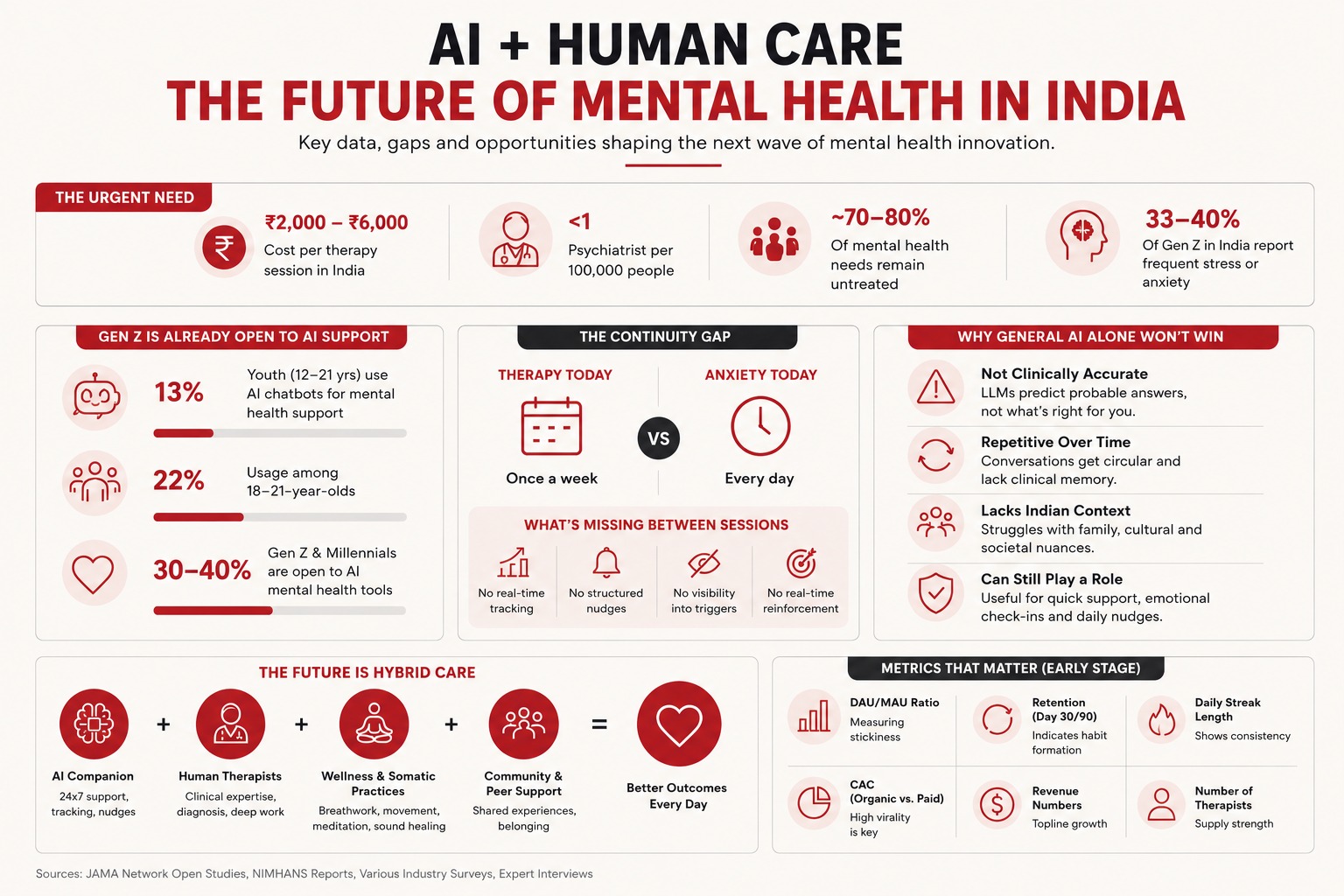
Therapy happens weekly. Anxiety does not.
A lot of therapy is insight-driven. It helps people understand past experiences, process trauma, and identify emotional patterns. That work is valuable, but it takes time.
The problem is that many young users today are looking for visible progress. They want something they can do at 2 AM when they are spiralling. They want small, practical nudges when stress hits before a meeting, after a breakup, during exam pressure, or while dealing with family expectations.
Current therapy marketplaces mainly help users find a therapist. That solves discovery, but it does not solve the continuity gap.
Between sessions, most users do not get real-time anxiety tracking, behavioural nudges, therapist visibility into daily triggers, or structured reinforcement. That is where the experience breaks.
AI In Mental Health: Why general AI tools are not enough
Gen Z is already using AI for emotional support. The behavioural shift is clear. Young people are comfortable talking to machines, especially when they want privacy, speed, and non-judgmental responses.
But general LLMs cannot win this category on their own.
Mental health is not just about generating comforting sentences. A generic model may sound empathetic, but it does not understand clinical progression, emotional context, cultural nuance, or risk. It can become repetitive over time. It may suggest advice that feels right in a Western individualistic setting but fails completely in an Indian family structure.
For example, telling an Indian woman to “set boundaries” without understanding joint family pressure, social expectations, financial dependence, marriage norms, or stigma around divorce can be shallow and even harmful.
India needs contextual AI for mental health. That means systems trained with deep clinical insight, Indian social context, privacy safeguards, and therapist involvement.
The moat is not the model. It is context.
Anyone can build on top of existing AI models. The real defensibility will come from proprietary clinical understanding, de-identified Indian case patterns, therapist-led design, and highly personalised intervention libraries.
A user with OCD should not receive the same mindfulness prompt as someone facing exam anxiety. A person dealing with postpartum depression should not land on the same experience as a student in Kota under academic pressure.
Mental health products cannot be one-size-fits-all. The winning product will understand triggers, intensity, environment, behaviour, sleep, movement, emotional history, and therapist instructions.
The product should become a daily cognitive habit
I do not think the winning model is “AI therapist in a box.” I think it is closer to a daily mental fitness system.
A strong product could begin with a morning journaling hook, where users empty their thoughts before starting the day. It could offer low-stimulation tools such as breathing, sound meditation, calm progress trackers, grounding exercises, chanting, or short movement prompts.
It could integrate with Apple Health or Google Fit, because physical movement can be an important signal in emotional recovery. If a user’s mood dips and activity drops, the app could nudge them to take a 10-minute walk, do breathwork, or follow a therapist-approved exercise.
The product has to be sticky, but not addictive in the social media sense. Retention matters because emotional regulation is built through repetition. Daily streaks, Day 30 and Day 90 retention, and DAU to MAU ratio may matter more in the early stage than revenue numbers or consultation volume.
The future is hybrid care
The ideal solution is not only AI. It is hybrid human plus AI coaching plus a community layer.
For users, it should provide continuous monitoring, an empathetic and non-judgmental support space, guided practices, stronger hand-holding between sessions, and safe access to different healing modalities such as meditation, somatic work, movement, sound healing, inner child work, and creative expression.
For therapists, it should provide better data. Instead of relying only on what a user remembers during a session, therapists could see patterns across mood, triggers, duration, intensity, sleep, movement, and context. This would allow more personalised interventions.
Human psychology is complex. Different people respond to different modalities. Some need talk therapy. Some need body-based practices. Some need community. Some need structure. Some need clinical care. A good product should know when to support, when to nudge, and when to escalate to a human professional.
The real North Star
The goal should not be to keep users dependent forever.
The goal should be outcome-oriented. After structured use, a person should ideally need less external intervention and use the app mainly for daily emotional regulation.
That is the promise of AI in mental health for India. Not replacing care, but making care more continuous, contextual, affordable, and human.
Because the real problem is not that people do not want help. It is that help is often too expensive, too late, too episodic, or too disconnected from daily life.
AI can help close that gap, but only if it is built with clinical responsibility, Indian context, privacy, and deep product thinking at the centre.
Also Read: CHOSEN Secures $5 Million Series A to Expand Science-Backed Skincare Portfolio