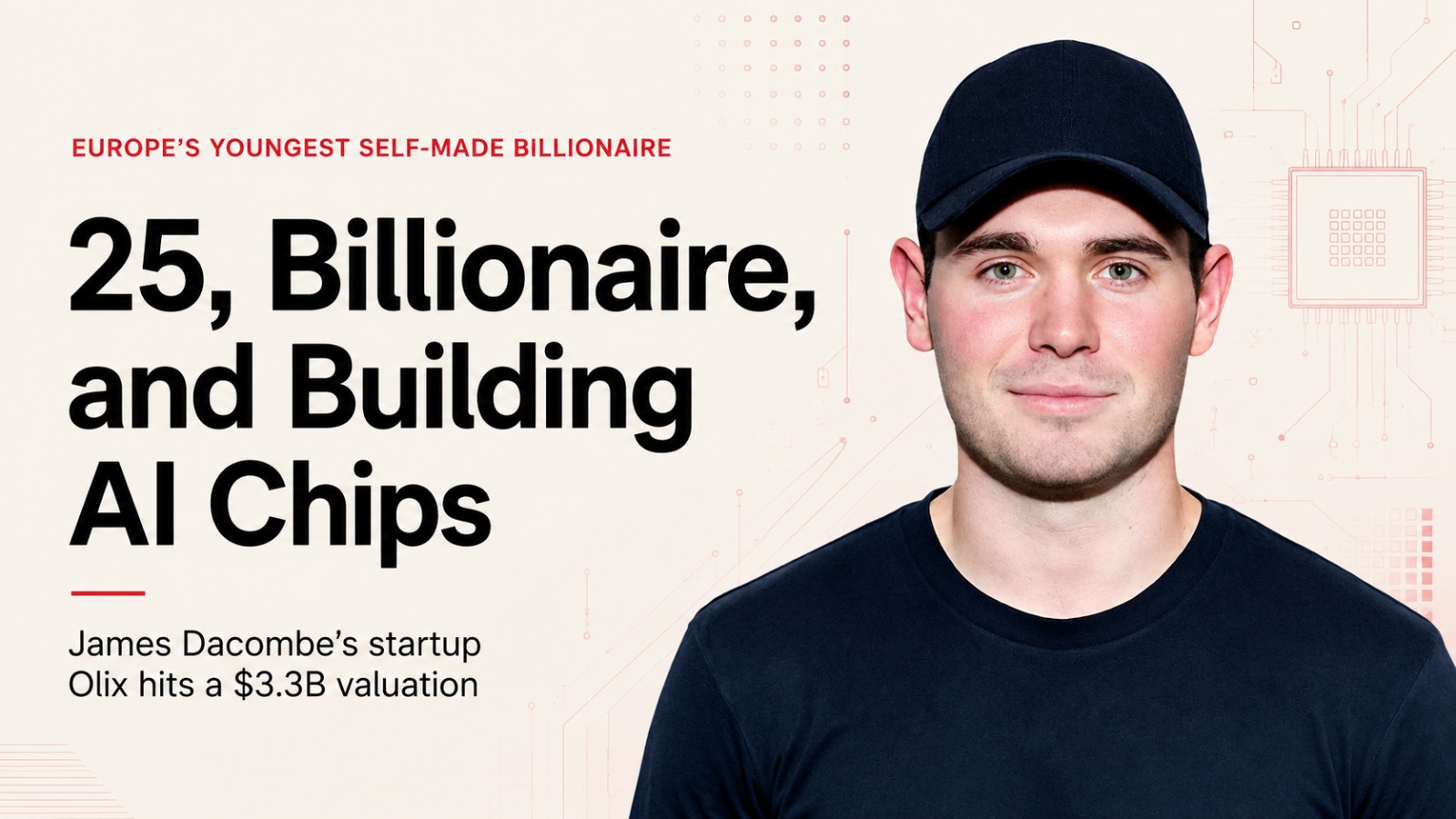
The British founder James Dacombe began programming at 13 and built his first technology company at 17. Now, a $312 million funding round for AI chip startup Olix has taken the company to a $3.3 billion valuation and pushed Dacombe into a very small club of young self-made billionaires.
James Dacombe’s path into the billionaire ranks can be traced back to a decision he made long before artificial intelligence became one of the hottest areas of global technology investment.
He began programming at 13. A few years later, conventional education had already started to lose its pull. Dacombe left sixth-form college in Harrogate after only two days and, at 17, turned his attention to building a company.
Eight years later, the British entrepreneur is 25, the founder of two technology businesses and, according to Forbes estimates cited in the reports, Europe’s youngest self-made billionaire.
The immediate reason is Olix.
The London-based AI chip startup raised $312 million in early August, lifting its valuation to $3.3 billion. Only six months earlier, Olix had been valued at just over $1 billion following a $220 million funding round in February.
That sharp rise in private-market valuation changed the arithmetic around Dacombe’s personal fortune.
Forbes estimates that he owns around 30% of Olix. At the latest valuation, that holding is worth close to $1 billion on paper. His separate stake in brain-technology company CoMind adds another layer to his wealth.
It is an extraordinary outcome for a founder who only established the company that became Olix in 2024.
Before AI chips, there was brain technology
Olix may have created the latest jump in Dacombe’s fortune, but it was not his first attempt at building a difficult technology business.
At 17, he founded CoMind, a medical technology company working on non-invasive systems for monitoring the brain. The company is developing technology intended to give clinicians information about cerebral blood flow and other measures of brain function without relying on invasive procedures.
Dacombe remains CoMind’s founder and chief executive.
In 2025, the company raised $102.5 million to support clinical trials, regulatory work and preparations for manufacturing its first product. CoMind did not disclose its valuation.
Forbes estimates that Dacombe retains a 12% stake in the company.
His early years as a founder also led him to the Thiel Fellowship, the programme established by technology investor Peter Thiel to support young entrepreneurs pursuing businesses outside the conventional university route.
Dacombe has previously described youth itself as an advantage when starting a company. His argument was essentially that a lack of accumulated caution can make a young founder more willing to try things that experienced people may already have decided will not work.
In his case, that willingness eventually stretched across two very different technical fields: brain monitoring and artificial intelligence infrastructure.
Olix is betting on what happens after an AI model is trained
The billionaire headline tells only part of the Olix story.
The company is developing specialised processors for AI inference. Inference is the stage at which a trained AI model receives new information and produces an output or response.
Olix is also working with photonic interconnects, using light to move data as part of an effort to increase performance and energy efficiency while lowering the cost of running large AI models.
The company is entering a market where Nvidia remains the overwhelming incumbent, but Olix is betting that the next phase of AI computing will create room for processors designed around more specific workloads rather than one general-purpose architecture handling everything.
That remains a technology bet rather than a finished commercial story.
Olix expects to complete the design of its chip by the end of 2026, with products targeted for delivery in 2027.
Still, investors have already placed a multibillion-dollar value on that ambition.
The latest round was led by New York investment firm Fundomo. Other participants included British chip designer Arm, quantitative trading firm Hudson River Trading, Netflix co-founder Reed Hastings and Britain’s government-backed Sovereign AI Fund.
Olix now employs more than 140 people, with operations spanning London, Bristol, Toronto and the United States.
For a company founded in 2024, the pace of expansion has been striking.
A six-month valuation jump changed Dacombe’s wealth
The numbers explain why Dacombe’s profile has suddenly moved beyond the technology industry.
After raising $220 million in February, Olix was valued at a little over $1 billion. By early August, another $312 million financing had taken the valuation to $3.3 billion.
For someone estimated to own around 30% of the business, that increase has enormous consequences.
It is also important to distinguish private-company wealth from cash in the bank.
Both Olix and CoMind are privately held. Their valuations are based on financing rounds, and the value attributed to Dacombe’s shares could rise or fall in later transactions. CoMind has not disclosed a valuation either.
That means an exact figure for his personal net worth is difficult to establish with precision.
What the latest financing does provide is enough private-market value for Forbes to place him among the world’s youngest self-made billionaires and identify him as the youngest in Europe.
Forbes also places Dacombe among only 11 self-made billionaires worldwide who are under 30, with just four of that group based outside the United States.
The more interesting story is what happened between 17 and 25
The headline number is $1 billion. The more revealing number may be eight years.
At 17, Dacombe was building a brain-monitoring startup rather than following the standard university route. By 25, he had built a second company in one of the most capital-intensive and competitive parts of the AI industry.
Neither company is a simple consumer internet startup. CoMind is pursuing medical technology that requires clinical and regulatory work. Olix is trying to develop specialised computing hardware in a semiconductor market dominated by some of the most powerful companies in technology.
That makes Dacombe’s rise less a story about leaving school and instantly becoming wealthy, and more a story about the sequence of increasingly ambitious technical bets that followed.
CoMind came first. Olix created the valuation surge. Investors supplied the capital. And an estimated 30% ownership position meant that when Olix reached $3.3 billion, its founder’s personal financial position changed with it.
The next chapter will depend less on a billionaire ranking and more on execution.
Olix still has to finish its chip design and move towards the products it is targeting for 2027. CoMind, meanwhile, is working through the clinical, regulatory and manufacturing stages required to bring its technology forward.
For now, though, the distance travelled is unusually compressed: programming at 13, founding a company at 17, launching an AI chip venture in his early twenties, and reaching Europe’s youngest self-made billionaire ranking at 25.
All before the second company has delivered its first targeted commercial chips.
Also Read: Why Is Nike Stock Falling? $1 Billion China Risk Weighs on NKE