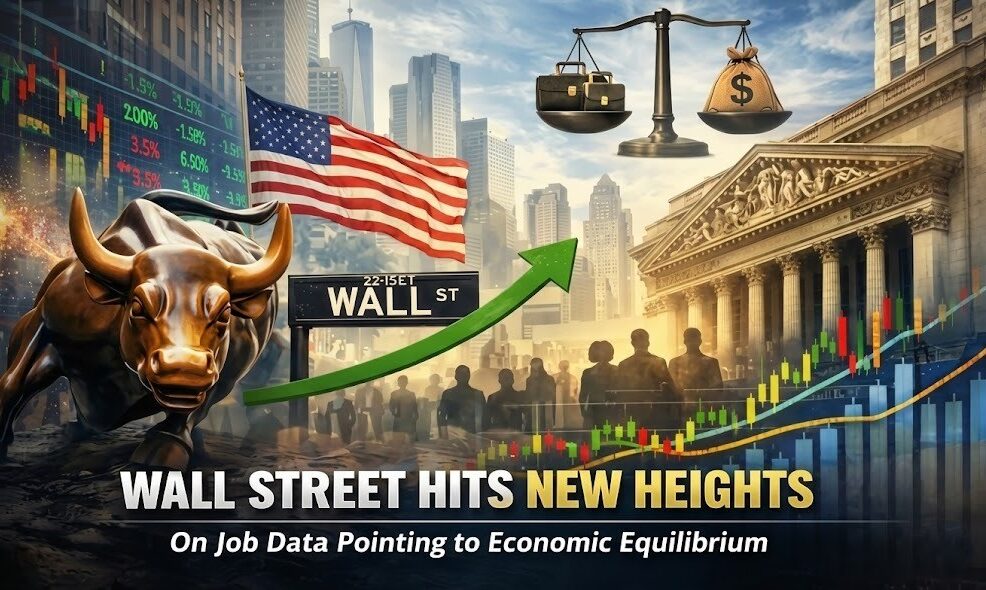
The U.S. equity markets closed at new record levels, indicating an increasing investor confidence that the largest economy in the world is slowing down in an organized way rather than going into recession. The rally was after the publication of mixed employment information that indicated poorer-than-anticipated job creation in December, yet a better-than-anticipated unemployment rate.
The S&P 500 gained 0.6 percent and ended at 6,966.28, better than it was at its all-time high. The Dow Jones Industrial Average was up 237 points, or 0.5 percent, at 49,504.07, and the Nasdaq Composite was up 0.8 percent at 23,671.35, overtaking the market.
A delicate signal is sent out by the labor market
The U.S. Labor Department reported that the jobs created by employers were below the expectations projected by the economists, indicating a slowing rate in hiring. Nevertheless, the unemployment rate decreased, promoting the idea that the labor market is resilient in nature. Economists are increasingly characterizing the period as one of low hiring and low firing, due to which the risk of economic contraction is minimized and the effect of inflationary pressure is decreased. This is essential to markets. Reduced interest rate increases will slow down the pace at which jobs are generated, and a steady unemployment rate will give investors optimism that consumer demand will not collapse.
Interest Rates: Godfather Will Be Quick to Slack.
The job figures led traders to reduce their anticipations of a swift interest reduction by the U.S. Federal Reserve within its forthcoming policy conclave. The current market prices indicate a limited likelihood of a reduction in the near future; still, investors anticipate at least two cuts in the rate throughout the year.
The Federal Reserve has been walking on eggshells because inflation has not decreased to the 2% mark as it should. Analysts also observe that whereas the cuts in the rates might be expected in 2026, they will be based on the incoming data and not market pressure.
Also Read: Budget 2026: Why India’s Economic Strength Is Turning Seaward
The market momentum is based on energy and technology.
One of the main motives behind the rally was the energy industry, especially businesses that are in line with the growing needs of the big tech companies. Vistra, a producer of power, shot up by more than 10 percent upon agreeing to a 20-year deal with Meta Platforms to provide nuclear-generated energy following the rising data center energy requirements of artificial intelligence.
In the same case, nuclear technology company Oklo had almost an 8 percent gain after a separate agreement associated with fuel supply and development of infrastructure. These transactions point to a larger trend at the global level, with digital development becoming more and more intricately connected with long-term energy security.
Mortgage Securities Surge on Signals of Policy
Stocks in housing and construction issues were also recording high returns following the plan of reducing the mortgage rates by U.S. President Donald Trump, who announced his plans to purchase mortgage-backed securities in large numbers. The announcement increased the confidence in the housing sector, and the suppliers and the homebuilders registered some of the largest gains during the day.
Business Paranoia Stokes Hope
Not every company joined in the rally. General Motors was down by almost 3 percent as it announced that financial outcomes would be hit by a withdrawal in the electric vehicle investments of 6 billion dollars. The car manufacturer blamed lower demand on fewer tax subsidies and less stringent emission regulations.
WD-40 consumer products company also fell following the company’s quarterly outcomes that showed lower profits compared to expectations, although the management claimed that the weakness was caused by timing factors instead of decreased consumer demand.
Policy uncertainty is an indicator of bond markets
The yields in the bond market moved opposite ways. The 10-year yield of the U.S. Treasury bond subsided to 4.16, and the two-year yield that is more responsive to the Federal Reserve policy anticipations increased to 3.53. The break suggests uncertainties regarding the rate and time of the monetary easing.
Global Markets Take Comfort
Market confidence resonated across international markets beyond the US. Key stock markets in Europe and Asia have ended on the upside, with France’s CAC 40 increasing by 1.4 percent and Japan’s Nikkei 225 by 1.6 percent, indicating an overall optimism in the economic position of the whole world.
Why This Matters for India
To India, the Wall Street rally is not just a far-fetched headline. The stable economy of the U.S. would facilitate international capital flows and the willingness of the investors to venture into the emerging markets. Meanwhile, the restrained Federal Reserve indicates that the interest rates in the world could be higher than thought, and the Indian policymakers and investors need to balance their needs to grow with their financial prudence.
Essentially, the exuberance in the record highs in Wall Street is not a free ride but rather a comfort. The markets are betting that the next few months will be characterized by economic moderation and not radical acceleration or collapse.
Also Read: The Quiet Triumph of Simmer Eats: £36 Million Built From Scratch